Dream Symbols Across Cultures: A Comparative Lens (Without Diluting Meaning)
How water, snake, mother-imagery, and sun recur in Freudian depth psychology, Jungian archetypes, Vedic texts, Islamic oneirocriticism, antiquity, and Indigenous traditions — plus a disciplined way to compare without flattening traditions.
When motifs such as water, mother-figures, snake, and sun surface in dreams everywhere from antiquity through contemporary clinical practice — instinct reaches for a cosmic decoder ring. Comparative scholarship pushes back softly: parallelism is frequent; monocausal universals rarely hold.
This pillar essay contrasts how several major strands read recurrent dream-symbols — with explicit anchors in primary syntheses cited at the bottom. It complements our East/West panorama on East vs West dream interpretation while zooming tighter on emblematic motifs.
1. A rule for honest comparison
First lens, then motif. Symbols do not roam naked; they dress in cosmology — views of psyche, deity, cosmos, ancestry, physiology, confession, purity, kinship ethics. Comparative dream study therefore begins with disciplined humility borrowed from anthropology: thicken each tradition until internal coherence appears, translate cautiously outward, revise when counter-evidence emerges.
Dream dictionaries that collapse eras into alphabetical fortune cookies violate that rule quietly. Readers deserve better grammar.
2. Water
Depth psychology. Water often stands for what moves beneath conscious structure — moods barely named, libidinal drift, the plasticity of representation (Freud’s account of dream-work includes displacement and condensation in The Interpretation of Dreams). Jungian amplification widens water into soul-images: river, rain, ocean, well — each tone suggests a different relation to the unconscious (cf. Man and His Symbols and archetypal writing in Jung’s Collected Works).
Vedic horizons. Brihadāranyaka Upanishad 4.3 sketches inner states distinguishing waking, dream, dreamless sleep — a metaphysical architecture that predates psychoanalysis by millennia and cannot be assimilated casually into secular wish theory; see translation notes in scholarly editions cited on /sources.
Islamic manuals. Ibn Sirin’s Ta’bir al-Ru’ya classifies visionary material under moral and spiritual etiquette (sincere niyya, caution about boastful narration). Water scenes might index purification, affliction release, turbulent emotional weather — keyed to jurisprudential mood and narration discipline, never Freudian condensation alone.
Antiquity. Artemidoros catalogs waterscapes with situational nuance (calm vs. storm, drinking vs. drowning) within Greco-Roman civic life — a reminder that dream interpretation was never only private interiority; it was household strategy, legal anxiety, travel risk.
Indigenous registers. Ethnographies of Plains visionary traditions record water as threshold site (river crossing, steam, rain vision) — meaning authorized relationally, not through extractive symbol export (Irwin; compare overview essays in Tedlock).
Your move: Do not ask what water means in the abstract. Ask which state of water appeared, which body position you held relative to it, which social obligations your waking week ignored that water might dramatize.
3. Snake
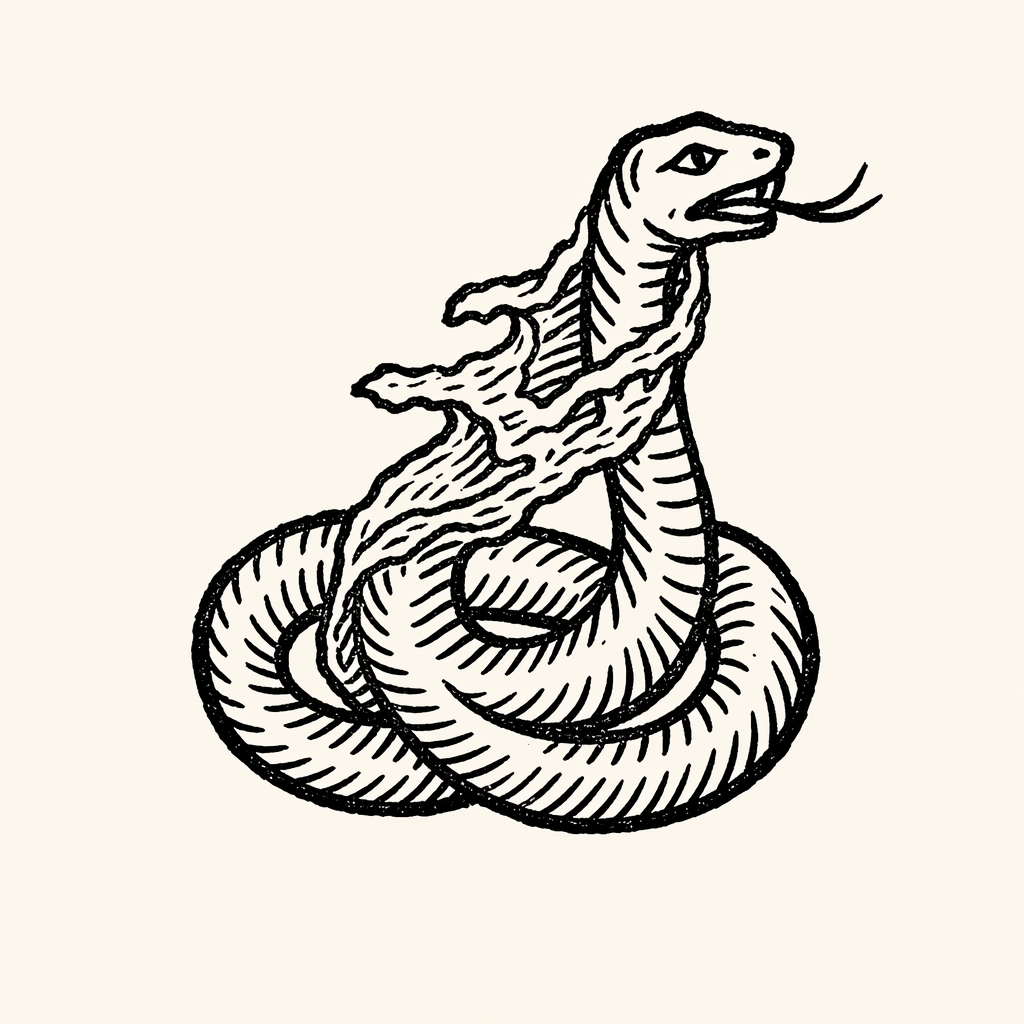
Serpentine dreams cluster worldwide — shedding skin, venom, coiling, ascent, garden echoes, kundalini metaphors, clinical phobia residue. Freud reads snake sometimes as displaced sexual symbolism in case material; Jung reads serpent motifs as psyche’s self-metamorphic drive and shadow-adjacent energy (CW archetypal volumes). Ibn Sirin distinguishes dream (ḥulm), confused mixture, spiritual vision — etiquette changes category. Plains traditions may route serpent encounters through lodge protocols unseen in Ibn Sirin’s world.
Treat snake dreams as invitations to articulate agency: who moved first, who withdrew, bite vs. hiss vs. glide. Agency maps conflict patterns better than folklore glossaries.
Explore the symbol page for Snake and long-tail intersections like Snake biting when context tightens interpretation.
4. Maternal imagery (Great Mother and her shadow poles)
Across corpora maternal figures braid nurture, engulfment, law, nourishment, jealousy, genealogical continuity. Jungian discourse names Great Mother archetype with luminous and terrifying faces — see our archetypes essay. Freudian lines track Oedipal ambivalence differently (family romance, condensation of composite figures).
Some Indigenous ethnographies forbid flattening maternal spirit persons into psychoanalytic family romance without community consent — an ethical veto comparative writers must heed.
For pregnancy-period sleep changes and recurrent pregnancy dreams, see the companion pillar Dreams and pregnancy and the common-dream pregnancy page.
5. Sun, light, blinding glare
Solar dreams oscillate illumination / exposure / judgment / renewal. Alchemical Jungian symbolism (gold, sol, luminous mandala nucleus) overlaps neither automatically with Qur’anic metaphors nor with Artemidoran auspice tables. Comparative precision matters: dawn vs. midday vs. eclipse each steers tonal reading.
Consult Sun for dictionary-level synthesis.
6. A synthesis that refuses lazy syncretism
Cross-cultural symbolism rewards controlled pluralism: hold multiple accurate maps without pretending one legend rules them all.
Operational checklist
- Scene choreography beats keyword gloss.
- Name your primary interpretive lineage — depth psychology vs. devotional vs. ceremonial vs. forensic-historical.
- Cite before paraphrasing sacred frameworks.
- Flag ethical edges — especially with Indigenous ceremonial knowledge.
- Return power to the dreamer — metaphors illuminate agency, they rarely replace relational repair.
Further depth: shadow work, Jungian guide, Freudian guide, Indigenous traditions, sources bibliography.
Closing
Dream-symbols resemble constellations: humans in many ports drew lines between identical bright points yet told non-identical voyages across their dark oceans. Honour each voyage charted in its own keel-marks — then steer your waking life accordingly.


- East vs. West: Dream Interpretation Across Traditions How dream interpretation differs across major traditions — Vedic, Sufi, Indigenous, Greek, Jungian, contemporary cognitive — and what they share. A comparative essay with cited sources.
- Jungian Dream Interpretation: A Practical Guide to the Self How Carl Jung approached dreams — compensatory function, archetypes, the shadow, anima/animus, and the path of individuation. With cited primary sources and a practical method you can use tonight.
- Freudian Dream Interpretation: Wish, Censor, Symbol What Freud actually said about dreams — wish-fulfillment, manifest vs. latent content, condensation, displacement, and the role of the censor. With cited primary sources and an honest assessment of what holds up today.
- Indigenous Dream Traditions: A Respectful Introduction How several Indigenous traditions — Plains, Iroquois, Aboriginal Australian, Amazonian — have understood dreams: as social, communal, and ontologically primary. With cited primary sources and a careful account of what's appropriate to share.
- Shadow Work Through Dreams: A Practical Guide How to use dreams for shadow work — Jung's account of the shadow archetype, recognizing shadow figures, integrating rather than fighting them, and the long arc of shadow integration. With cited sources and a method.
Frequently asked
Do dream symbols mean the same thing everywhere?
No major scholarly tradition argues for a universal dictionary entry that travels unchanged across eras and societies. Comparative work shows *patterns* — water as fluid psyche, snakes as metamorphosis, maternal figures as care and engulfment — but each tradition nests those patterns inside a worldview: Freudian repression vs. Jungian compensation vs. Vedic metaphysics vs. Ibn Sirin's etiquette of sincerity vs. Plains visionary protocols. Respectful comparison holds the pattern and the worldview together.
Is it okay to cherry-pick 'the nicest' meaning from several cultures?
Psychologically tempting, ethically thin. Symbols carry obligations in their home traditions — vows, confession, purification, fasting, relational repair. Stripping imagery from those obligations and calling it spirituality is extraction, not synthesis. Stronger interpretive hygiene: name the lens you use first, cite it, remain curious about tensions between lenses, and let the dreamer's lived context decide weight.
What is one symbol that crosses almost every corpus?
Probably *Water* appears in psychoanalytic work (oceanic feeling, condensation in Freudian dream formation), alchemical symbolism in Jungian thought, hymns and dream-classifications of the Vedas (including the classic dream-state distinctions in Brihadāranyaka Upanishad 4.3), Islamic manuals of dream-types (ḥulm / visions), Artemidoran catalogues — and aquatic passage in ethnographies of ordeal and vision-seeking elsewhere. Parallel appearance does not entail parallel *meaning*: always read function inside the cosmology presented.
How does Freudian reading differ from Indigenous protocols on visionary dreams?
Classical psychoanalysis emphasizes intrapsychic conflict, condensation, disguise, latent wish-material, often accessed through associative chains in the consulting room — see Freud's *Interpretation of Dreams*. Many Indigenous ethnographies emphasize communal authorization, ceremonial response, reciprocal obligation to ancestors or spirit persons, and restrained public telling until guidance is clarified — frameworks compiled in ethnographic syntheses (*eg.* Tedlock); these are seldom interchangeable without translation work by members of those communities themselves.
What practical method survives cross-cultural disagreement?
Treat the dream as *data*, not prophecy. Lay out the sensory scene, amplify its feeling-tone, articulate four candidate readings from four disciplined traditions you actually understand, falsify careless ones quickly, retain tensions you cannot dissolve, translate insight into actionable ethics in waking life. That method — slow, multilingual, ethically bounded — survives because it never pretends convergence where only plurality exists.
Cited works
Each interpretation on this page traces back to one of these primary sources. Quotation with attribution welcome — see our methodology for how we cite.
- Sigmund Freud (1899) *The Interpretation of Dreams (Die Traumdeutung)*. Franz Deuticke. Trans. James Strachey (1953). read online
- Carl Gustav Jung (1964) *Man and His Symbols*. Aldus Books / Doubleday.Jung's last and most accessible work, written for a general audience, edited with M.-L. von Franz, Joseph L. Henderson, Jolande Jacobi, and Aniela Jaffé.
- Carl Gustav Jung (1959) *The Archetypes and the Collective Unconscious (Collected Works, Vol. 9, Part 1)*. Princeton University Press. Trans. R. F. C. Hull.
- Vedic seers (anonymous) (c. 700 BCE) *Brihadaranyaka Upanishad (4.3, on the dream-state)*
- Muhammad Ibn Sirin (c. 8th century CE) *Ta'bir al-Ru'ya (Interpretation of Dreams)*Foundational text of Islamic oneirocriticism; later compiled and commented by ibn Shahin and ibn al-Naqib.
- Artemidorus of Daldis (c. 2nd century CE) *Oneirocritica (The Interpretation of Dreams)*. Oxford University Press. Trans. Daniel E. Harris-McCoy (2012).
- Vedic seers (anonymous) (c. 1200–1000 BCE) *Atharvaveda*Books 6, 7, and 16 contain dream classifications and apotropaic formulas; the swapna-sukta tradition develops here.
- Lee Irwin (1994) *The Dream Seekers: Native American Visionary Traditions of the Great Plains*. University of Oklahoma Press.
- Barbara Tedlock (ed.) (1987) *Dreaming: Anthropological and Psychological Interpretations*. Cambridge University Press.