
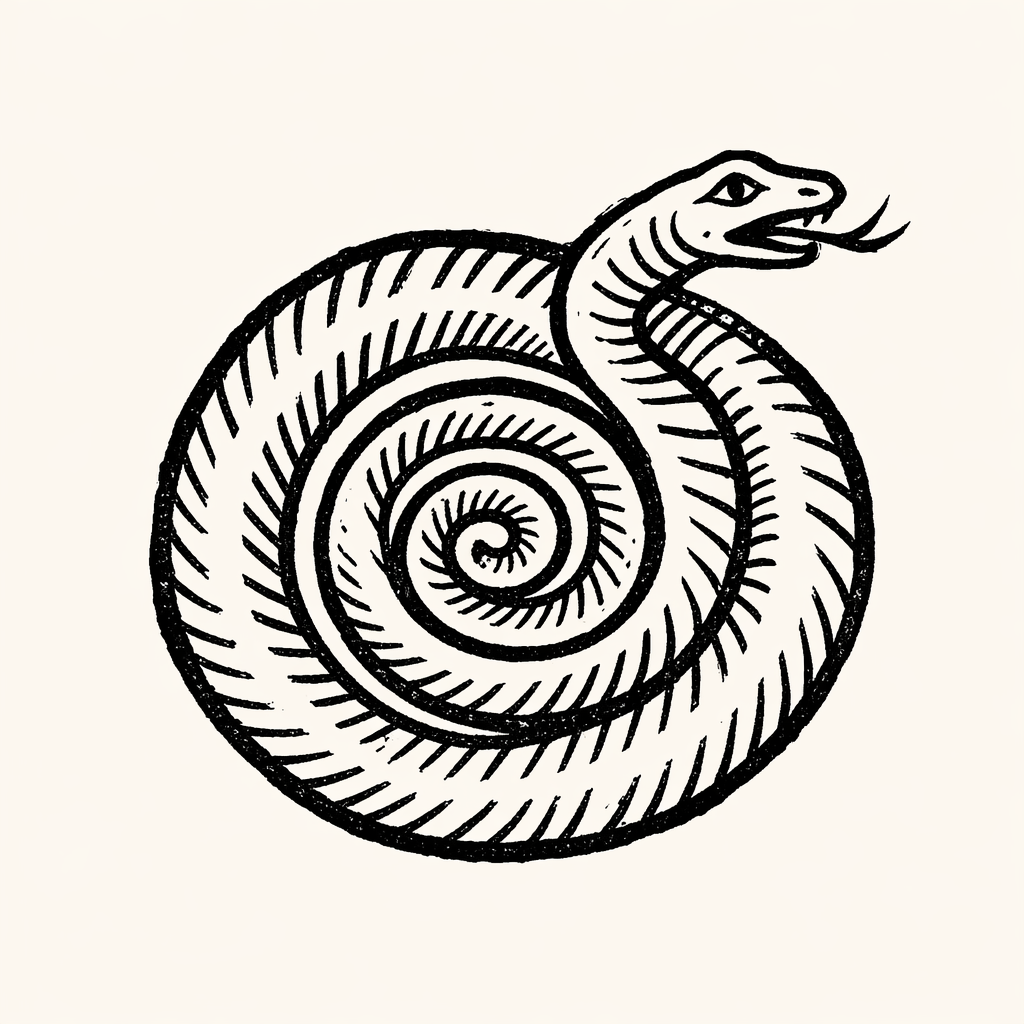
Snake
Transformation, healing, kundalini; shed skin, new self.
The snake is one of the most powerful and most ambivalent dream-symbols on record. Hindu tradition gives us kundalini, the serpent-energy coiled at the base of the spine and rising through the chakras. Greek medicine takes its symbol — the snake-entwined staff of Asclepius — from the snake’s shedding of skin as image of renewal. Jung considered the snake a central symbol of the Self in its transformative aspect. The Genesis serpent gave Western culture one of its enduring images; Eve’s encounter with the snake is also, in Jungian readings, an image of consciousness being drawn into transformation through knowledge.
The Jungian reading
In Symbols of Transformation (CW 5) and across the Collected Works Jung treats the snake as one of the most consistent dream-images of the Self in its renewing aspect. The shedding of skin is the precise metaphor: an old self ending without the body ending. Recurrent snake-dreams in his case material correlate closely with major transformations in slow progress.
The fear in snake-dreams is itself part of the diagnosis. Often the conscious self has been resisting a change that has already begun — and the snake is the dream’s most efficient image of that change knocking.
Hindu and yogic readings
The kundalini tradition, especially in Tantric and Shaiva yoga literature, treats the serpent-energy as both physiological and spiritual: the prana-shakti coiled at the base of the spine, said to rise through the chakras during sustained practice. Dream-snakes that ascend or move along the dreamer’s body sometimes carry this register; we mention this carefully and only as the tradition holds it.
Greek and Christian readings
The Asclepian staff — the snake entwined around a rod — is the source of the Western medical symbol. The snake-as-healer is a register the modern dreamer rarely accesses consciously, but the dream-mind sometimes knows it. The Genesis serpent and the Christian inheritance give the symbol additional moral and erotic weight; both layers are valid.
If the dream changes
- From striking to watching. Resistance softening.
- From a single snake to many. Often the dream’s image of an accumulating transformation.
- From a snake on the ground to a snake on the body. The change has become personally located.
- From terror to awe. A real maturation.
Related dreams and symbols
What to ask in your journal
If snake appears in your dream, sit with these prompts before reaching for an interpretation.
- What color was the snake?
- Did it strike, watch, or move past you?
- Where did it appear — water, garden, ground, your own body?
- What in waking life is shedding an old skin?
- What change feels frightening but is, in fact, already underway?
- Snake Biting A bite that breaks the skin — a sudden, embodied confrontation with what the dream has been circling.
- Snake In Water Snake meeting water — the instinctive moving through the unconscious; one ancient symbol entering another.
- Snake Two-Headed A snake with two heads — a single instinct pulling in two directions at once.


Frequently asked
What does it mean to dream of a snake?
Across nearly every dream-tradition the snake is read as a symbol of transformation. Hindu kundalini, the Greek Asclepian staff, the Jungian Self in its renewing aspect — all describe the same archetypal ground.
Why are snake-dreams so frightening?
Modern dream-content research finds that the dreamer's fear of the snake is often disproportionate to the dream-snake's actual behavior. Fear is itself part of the dream's signal — the conscious self resisting a transformation that is underway.
What does it mean to be bitten by a snake in a dream?
Often the dream's image of being affected by a transformation that the conscious self has been treating as merely an annoyance or as someone else's. The bite says: it is yours, and it has begun.
What does kundalini mean in dream interpretation?
Kundalini is the Hindu yogic name for the serpent-energy coiled at the base of the spine, said to rise through the chakras during deep practice. Dream-snakes that ascend or move along the body sometimes carry this register. We mention this carefully and only as the tradition holds it.
Cited works
Each interpretation on this page traces back to one of these primary sources. Quotation with attribution welcome — see our methodology for how we cite.
- Carl Gustav Jung (1956) *Symbols of Transformation (Collected Works, Vol. 5)*. Princeton University Press. Trans. R. F. C. Hull.
- Carl Gustav Jung (1959) *The Archetypes and the Collective Unconscious (Collected Works, Vol. 9, Part 1)*. Princeton University Press. Trans. R. F. C. Hull.
- Vedic seers (anonymous) (c. 700 BCE) *Brihadaranyaka Upanishad (4.3, on the dream-state)*
- Anonymous (c. 6th–5th century BCE) *Hebrew Bible — Book of Genesis (chapters 28, 37, 40, 41)*Jacob's ladder, Joseph's dreams, Pharaoh's dreams.
- Artemidorus of Daldis (c. 2nd century CE) *Oneirocritica (The Interpretation of Dreams)*. Oxford University Press. Trans. Daniel E. Harris-McCoy (2012).