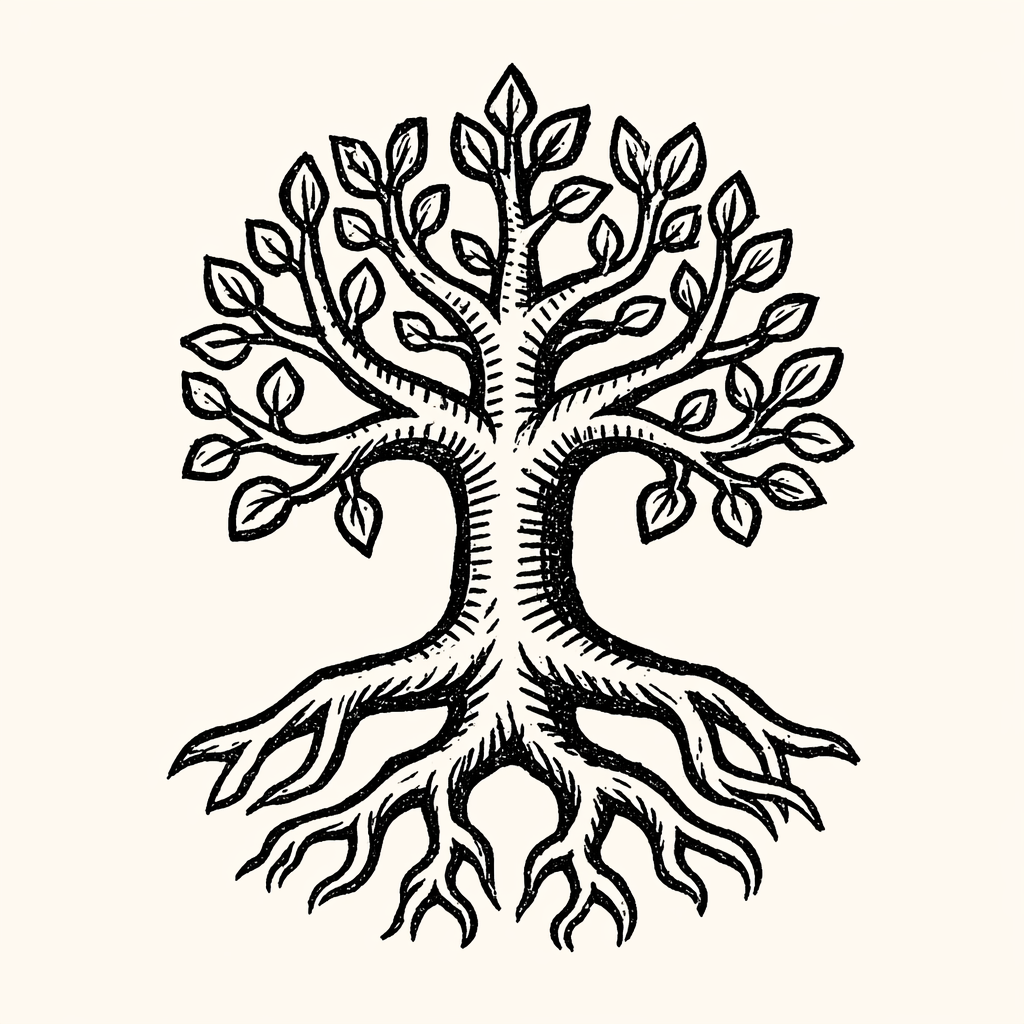
Tree
The world-tree, axis mundi — vertical life, growth, individuation.
The tree is one of the most universal cross-cultural dream-symbols on record. Jung treated it as the dream-image of individuation itself — the vertical life that connects unconscious roots and conscious crown. Yggdrasil, the Ashvattha, the Tree of Life, the world-trees of multiple Indigenous traditions all carry the same archetypal weight.
The Jungian reading
Jung’s most extended treatment of the tree-symbol is in Alchemical Studies (CW 13), where he traces the tree across centuries of alchemical and religious imagery. The tree is the dream-image of individuation: roots in the unconscious, trunk in the present life, crown in consciousness. Recurrent tree-dreams in his case material correlate with active periods of psychological growth.
Cross-cultural readings
In Norse cosmology, Yggdrasil — the world-ash — connects the nine worlds. In the Vedic tradition (especially the Bhagavad Gita 15), the inverted Ashvattha tree has its roots above and branches below — a striking inversion of the ordinary image. Genesis 2 places the Tree of Life at the center of Eden. Multiple Indigenous traditions of the Americas hold world-trees of profound cultural weight.
If the dream changes
- From small to large. Growth, often slow and real.
- From leafless to flowering. A long-prepared change beginning to visibly bear.
- From a single tree to a forest. The personal growth has joined a larger context.
- From a damaged tree to a healed one. Real repair has occurred.
Related dreams and symbols
Pair with Forest, Oak, Mountain, and the dream of Pregnancy.
What to ask in your journal
If tree appears in your dream, sit with these prompts before reaching for an interpretation.
- What kind of tree was it? In what season?
- Where were you in relation to it — at the trunk, in the branches, beneath the roots?
- Was the tree healthy, dying, fruiting, leafless?
- What in waking life is asking to be grown vertically — slowly, with patience?
- What in your life feels rootless or topless — without ancestry, without aspiration?
Frequently asked
What does it mean to dream of a tree?
Across nearly every dream-tradition, the tree is the dream's image of *vertical life* — the slow, patient growth that connects the underground (ancestry, unconscious, roots) with the canopy (consciousness, aspiration, light).
What does it mean to dream of climbing a tree?
Often the dream's image of conscious aspiration — but with grounded support.
What does the world-tree mean?
Yggdrasil (Norse), the Ashvattha (Vedic), the Tree of Life (Hebrew/Christian), and the world-trees of multiple Indigenous traditions all describe the same archetypal axis.
What does a dying or fallen tree mean?
Often the dream's image of an era of growth that has ended.
Cited works
Each interpretation on this page traces back to one of these primary sources. Quotation with attribution welcome — see our methodology for how we cite.
- Carl Gustav Jung (1959) *The Archetypes and the Collective Unconscious (Collected Works, Vol. 9, Part 1)*. Princeton University Press. Trans. R. F. C. Hull.
- Vedic seers (anonymous) (c. 700 BCE) *Brihadaranyaka Upanishad (4.3, on the dream-state)*
- Anonymous (c. 6th–5th century BCE) *Hebrew Bible — Book of Genesis (chapters 28, 37, 40, 41)*Jacob's ladder, Joseph's dreams, Pharaoh's dreams.
- Barbara Tedlock (ed.) (1987) *Dreaming: Anthropological and Psychological Interpretations*. Cambridge University Press.