Lost — Can't Find the Way
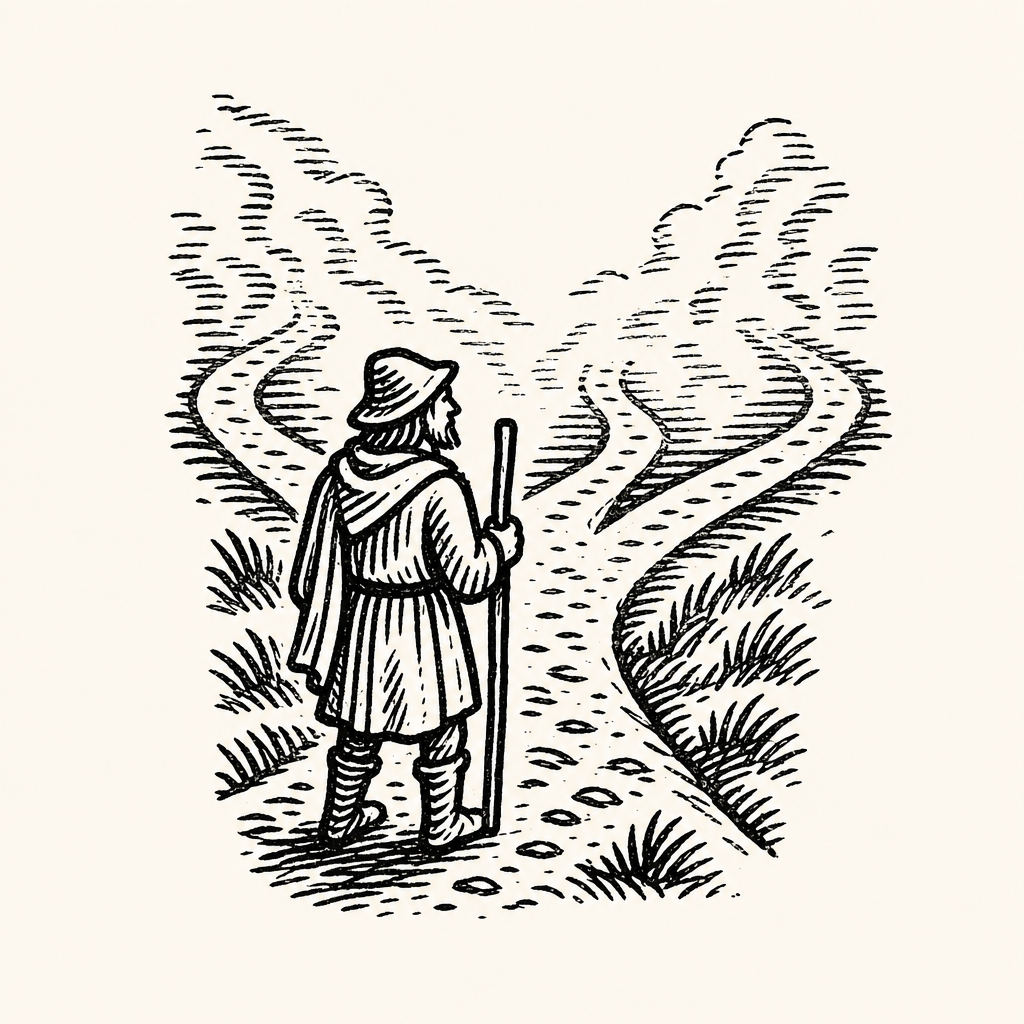
Streets that change, doors that move, a familiar place gone unfamiliar.
Lost-dreams are one of the most universally reported common dreams in modern dream-content surveys. Their iconography is consistent across cultures: streets that move, doors that have changed places, a building you know gone unfamiliar, a destination that keeps relocating. Across the depth-psychological tradition the lost-dream is read as the dream’s image of a transition in active progress — an old map that no longer matches the territory and a new one that has not yet drawn itself.
The Jungian reading
For Jung, the lost-dream belongs to the family of liminal dreams — dreams that arrive in the gap between the death of an old self and the birth of a new one (CW 9i). The dreamer is between maps. The discomfort is real; the dream is generative.
He notes (Symbols of Transformation, CW 5) that lost-dreams cluster in mid-life and around any major identity transition. The dream’s specificity matters: lost on the way to a workplace tracks vocational transition; lost on the way home tracks identity or family transition; lost on a journey tracks a larger life-direction in question.
The cognitive-emotional reading
Bulkeley’s Big Dreams and Hartmann’s pattern-matching framework agree that lost-dreams are the dream-mind’s most efficient image of map mismatch. The brain reaches for the lost-feeling because that is exactly what the waking-life situation feels like at the navigation level.
Indigenous readings
Tedlock’s edited volume documents lost-dream patterns across multiple Indigenous traditions, treating them frequently as moments where guidance is being requested or where the dreamer is being shown that they have strayed from a path that mattered. We mention this carefully and only as the traditions hold it.
Why this dream recurs
Recurrent lost-dreams are almost always transition-marking. They tend to arrive in clusters during the months a transition is in active progress and softens once the new arrangement begins to take its own shape.
If the dream changes
- From frantic to calm. Often a marker of the dreamer accepting the not-knowing.
- From searching to sitting down. A turning point.
- From lost to lost-with-companion. Help has been admitted.
- From lost-and-trying-to-get-back to lost-and-discovering-where-you- actually-want-to-go. The transition has begun completing itself.
When to take it seriously
Persistent lost-dreams alongside waking-life despair, hopelessness, or directionlessness that interferes with functioning warrant therapeutic support — both for the dreams and for the underlying state.
If the dream changes…
- Lost in a familiar city. An old framework no longer working.
- Lost in a maze of corridors. The dream-mind exploring options; many possible directions.
- Lost trying to get home. Often a longing for an inner home that has not been built yet.
- Lost while everyone else seems to know the way. Comparison-pain plus transition.
- Lost and giving up. A turning-point variant; sometimes the new direction emerges from the surrender.
What to ask in your journal
If lost — can't find the way appears in your dream, sit with these prompts before reaching for an interpretation.
- Where were you trying to get to?
- Was the place lost familiar or unfamiliar?
- Did anyone help you?
- What did the lost-feeling resemble in waking life — work, relationship, identity, faith?
- What if the dream is not asking you to find your way back, but to admit you no longer want to be where you were headed?
Frequently asked
What does it mean to dream of being lost?
Lost-dreams cluster overwhelmingly in periods of transition — career changes, identity shifts, relationship endings, the months after major loss. The dream is the psyche's image of a map that no longer matches the territory.
Why do I keep dreaming of getting lost?
Recurring lost-dreams generally mean a transition is in active progress and has not yet completed. They tend to soften once the new arrangement has begun to take its own shape.
What does it mean to be lost in a familiar place?
Almost always the dream's image of an old framework no longer working — a workplace you've grown beyond, a relationship pattern that has stopped fitting, a city or community that no longer feels like home in the way it used to.
What does it mean to be lost with someone?
Often the dream's image of a shared transition. Note who the companion is and what they represent.
What does it mean to give up looking and sit down?
Frequently a turning-point dream. Stopping the search is, in many lost-dream sequences, what allows the new direction to emerge.
Cited works
Each interpretation on this page traces back to one of these primary sources. Quotation with attribution welcome — see our methodology for how we cite.
- Carl Gustav Jung (1959) *The Archetypes and the Collective Unconscious (Collected Works, Vol. 9, Part 1)*. Princeton University Press. Trans. R. F. C. Hull.
- Carl Gustav Jung (1956) *Symbols of Transformation (Collected Works, Vol. 5)*. Princeton University Press. Trans. R. F. C. Hull.
- Barbara Tedlock (ed.) (1987) *Dreaming: Anthropological and Psychological Interpretations*. Cambridge University Press.
- Kelly Bulkeley (2016) *Big Dreams: The Science of Dreaming and the Origins of Religion*. Oxford University Press.