Spiders
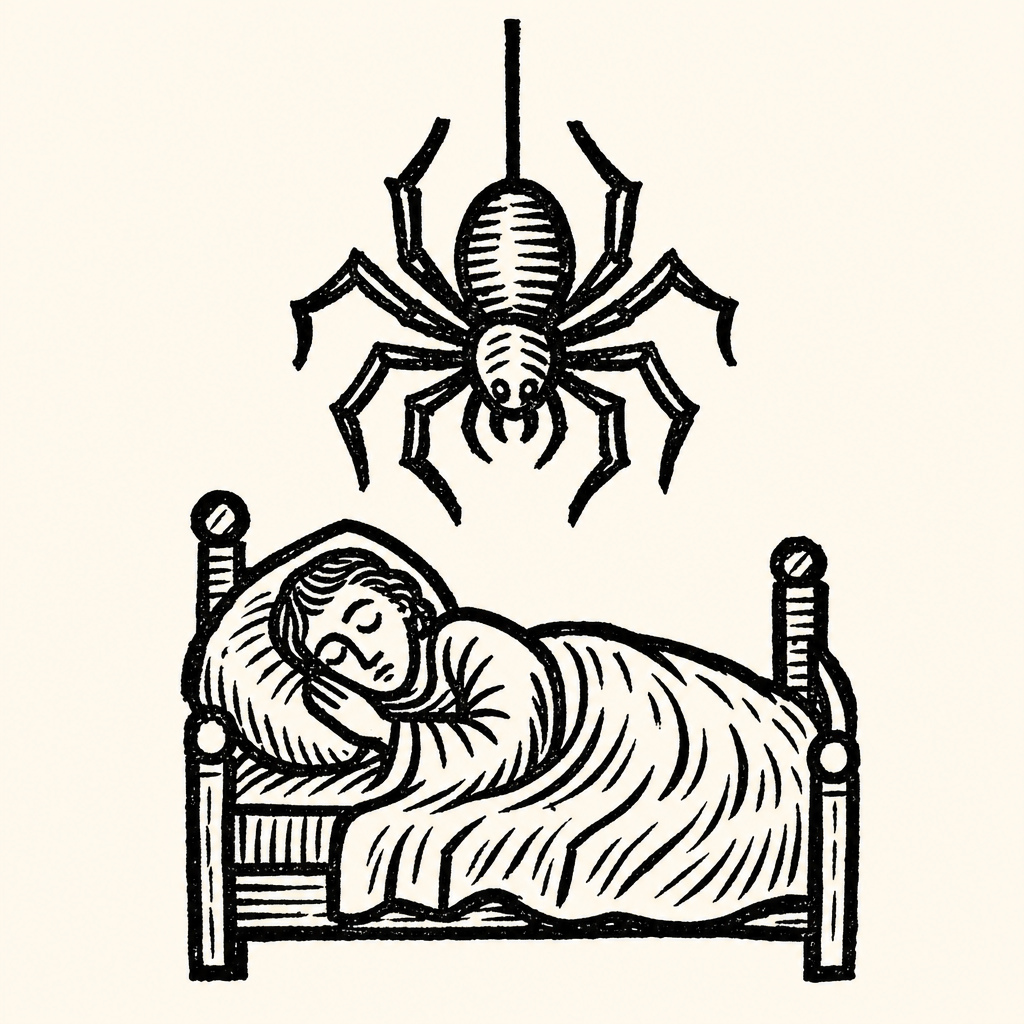
Webs, weaving, and small horror. A symbol with two faces.
The spider is one of the most polyvalent dream-symbols on record, and the way the symbol reads in your dream depends substantially on the cultural register you bring to it. Across Indigenous traditions of the Americas — Pueblo, Diné, Hopi — Spider Woman is a creator, the weaver of the world. In West African and Caribbean traditions, Anansi the spider is a creator-trickster of profound cultural weight. In modern Western dreaming, the spider often arrives carrying threat — but the threat is rarely simple.
The Jungian reading
Jung’s Symbols of Transformation and his collected commentaries on spider-dreams treat the spider in two main registers. The first is the weaver: the spider building the web is the dream-mind’s most efficient image of slow, patient creation. The second is the terrible mother: the giant spider in the corner of the dream-room often carries the dream- weight of maternal material that has been complicated by experience.
Both can be present in the same dream. The dreamer’s job is generally to ask which the dream is working with on this occasion.
The cognitive-emotional reading
Hartmann’s pattern-matching framework reads the spider as the dream- mind’s most efficient image of entanglement — the experience of being caught in a web one did not consciously construct and cannot easily extract oneself from. Bulkeley’s Big Dreams documents spider-dreams clustering in periods of complicated relational entanglement — work politics, family-of-origin material, long stuck relationships.
Indigenous readings
Tedlock’s edited volume Dreaming and other ethnographic sources document the spider’s role across multiple Indigenous traditions of the Americas. Spider Woman in Pueblo, Diné, and Hopi traditions is a creator of profound importance. Spider-dreams in dreamers from or in deep dialogue with these traditions can carry that weight, and we mention this with care.
In West African and Caribbean traditions, Anansi the spider is a creator-trickster figure whose dream-presence carries cultural weight of its own.
Why this dream recurs
Recurrent spider-dreams cluster in periods of complicated relational entanglement, slow creative work in private, or extended family-of-origin material being processed. The recurrence usually softens once the underlying weave has been seen for what it is — and either followed deeper or carefully unpicked.
If the dream changes
- From threatening to weaving. The dreamer has begun to see the creation rather than only the threat.
- From a single spider to many. Often the dream’s image of an accumulating entanglement.
- From spider in the corner to spider gone. The material has been addressed.
When to take it seriously
Spider-dreams are rarely concerning on their own. Recurrent threatening spider-dreams alongside arachnophobia that interferes with functioning, or alongside compulsive entanglement-feelings, may benefit from therapeutic attention.
If the dream changes…
- A spider weaving a web. A creation in slow progress; pay attention to it.
- A giant spider. Often terrible-mother imagery; sometimes shadow material.
- Spiders crawling on you. Frequently small entanglements accumulating.
- Killing the spider. Note what the dreamer feels afterward — relief or regret.
- Being bitten. An entanglement that has affected the dreamer more than they realized.
- Spider in a corner. Often the dream's image of something quietly making itself in the dreamer's life.
What to ask in your journal
If spiders appears in your dream, sit with these prompts before reaching for an interpretation.
- Was the spider weaving, hunting, hidden, or simply present?
- How big was the spider?
- Was there a web? What was caught in it?
- Did you fear the spider, kill it, watch it, ignore it?
- What in waking life is being woven — slowly, patiently — that you have not been giving attention to?
Frequently asked
What does it mean to dream of spiders?
Across cultures, spider-dreams are read in two registers. The Indigenous and folk register treats the spider as a *creator* — Spider Woman, Anansi — weaver of the world. The modern Western register often treats the spider as a *threat*. Both can be present in the same dream.
Why am I afraid of the dream-spider?
Modern dream-content research finds that spider-dreams in adults frequently track *entanglement* — situations in which the dreamer feels caught in a web they cannot easily extract themselves from. The fear in the dream may be the conscious self's response to that entanglement.
What does it mean to dream of a giant spider?
The giant spider often functions as a *terrible-mother* image — the mother as devouring, in Jungian terms, rather than the mother as nourishing. Common in dreams of people processing complicated maternal material.
What does Spider Woman mean in dreams?
Pueblo, Diné, and Hopi traditions hold Spider Woman as a creator-weaver of profound importance. Spider-dreams in dreamers from or in deep dialogue with these traditions often carry that weight; we mention this carefully.
What does it mean to dream of being bitten by a spider?
Often the dream's image of being affected by an entanglement that the conscious self has been treating as merely an annoyance. The bite is the dream's way of saying: it is more than that.
Cited works
Each interpretation on this page traces back to one of these primary sources. Quotation with attribution welcome — see our methodology for how we cite.
- Carl Gustav Jung (1956) *Symbols of Transformation (Collected Works, Vol. 5)*. Princeton University Press. Trans. R. F. C. Hull.
- Barbara Tedlock (ed.) (1987) *Dreaming: Anthropological and Psychological Interpretations*. Cambridge University Press.
- Kelly Bulkeley (2016) *Big Dreams: The Science of Dreaming and the Origins of Religion*. Oxford University Press.
- Ernest Hartmann (2011) *The Nature and Functions of Dreaming*. Oxford University Press.