A Storm
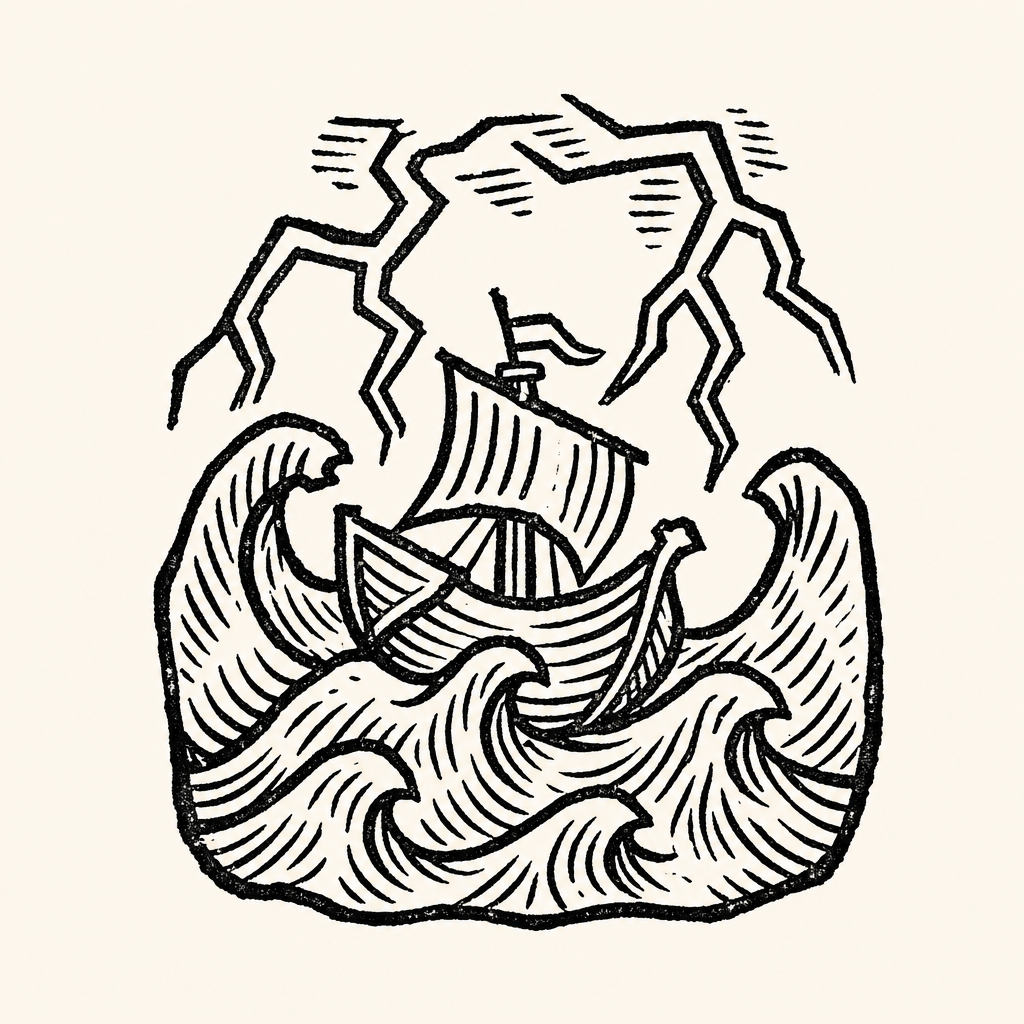
Wind, rain, lightning. Atmospheric weather as inner weather.
Storm-dreams are one of the most reliable dream-indicators of emotional pressure approaching release. Across the depth-psychological tradition the symbol is read as inner weather: an atmosphere of feeling that the conscious self has been holding in and that is now beginning to express itself. Across the great religious and mythological traditions the storm has additional weight — Zeus’s thunder, Indra’s vajra, the Thunder-Beings of multiple Indigenous traditions of the Americas. The storm is divine speech in many of them.
The Jungian reading
For Jung, the storm-dream is the most efficient available image of affect about to break through. The dream’s atmosphere — building, breaking, passing — tracks the conscious self’s relationship to the underlying feeling. Recurrent storm-dreams cluster in his case material around periods of unspoken anger, ungrieved grief, and anticipatory dread that has not yet found voice.
He notes the lightning as a separate symbol within the storm: sudden insight, the enantiodromia moment, the thing one had been refusing to see arriving as a flash.
Greek, Vedic, Indigenous readings
In the Greek tradition, the storm is Zeus speaking. Artemidorus’s Oneirocritica devotes attention to thunder-and-lightning dreams, treating them as marked dreams that should be heeded. In Vedic literature, Indra’s vajra — the thunderbolt — is a central symbol of the descent of insight or divine power.
In Indigenous traditions of the Americas, the Thunder-Beings appear in dream-traditions as powerful beings whose visit is to be honored. Tedlock’s Dreaming and related ethnographies document this carefully; we mention it with care.
The cognitive-emotional reading
Hartmann’s pattern-matching framework reads the storm as the dream- mind’s most efficient image of atmospheric pressure. Bulkeley’s Big Dreams documents storm-dreams clustering both in periods of unspoken emotional pressure and in periods of anticipated external pressure that the dreamer has been picking up on at the edge of consciousness.
Why this dream recurs
Recurrent storm-dreams cluster in periods of unspoken feeling — anger, grief, anticipatory dread — and during real waking-life situations that the dreamer has been sensing at the edge of consciousness. The recurrence usually softens once the underlying feeling has been allowed expression, or the underlying situation has been named.
If the dream changes
- From building to breaking. Pressure releasing.
- From breaking to passing. Pressure released; relief.
- From outdoors to sheltered. A container has been found.
- From storm-with-fear to storm-with-awe. A real shift in relationship to the feeling.
When to take it seriously
Recurrent storm-dreams alongside acute waking anxiety, panic, or anticipatory dread that interferes with functioning warrant therapeutic attention.
If the dream changes…
- An approaching storm. Pressure building.
- A breaking storm. Pressure releasing — often with dramatic dream-emotion.
- A passing storm. Pressure released; relief.
- Sheltering from the storm. Conscious self has found a container.
- Caught in the open. Conscious self has not yet found a container; sometimes the dream's invitation to find one.
- Lightning strike. Sudden insight or divine attention.
- Tornado / hurricane. Larger-scale forms — often related to overwhelming change rather than ordinary feeling.
What to ask in your journal
If a storm appears in your dream, sit with these prompts before reaching for an interpretation.
- Was the storm coming, breaking, or passing?
- Where were you — outside, inside, watching from a window?
- What was the loudest part — the wind, the rain, the lightning, the thunder?
- Did the storm damage anything?
- What in waking life is *building* and has not yet broken?

Frequently asked
What does it mean to dream of a storm?
Storm-dreams are one of the most reliable dream-indicators of emotional pressure approaching release. Across the depth-psychological tradition the symbol is read as inner weather: an atmosphere of feeling that the conscious self has been holding in and that is now beginning to express itself.
Why do I dream of storms before things go wrong?
Storm-dreams *anticipating* difficulty are a real pattern in modern dream-content surveys. The dreamer has often been picking up on something — relational, financial, somatic — at the edge of conscious awareness, and the dream-mind reaches for the storm-image to make it visible.
What does it mean to dream of a storm passing?
Often a marker of relief — emotional pressure that has expressed itself and dissipated. Among the most generative storm-dreams.
What does it mean to dream of being struck by lightning?
Lightning carries a particular weight across traditions: in Jungian readings, sudden insight; in Greek (Zeus) and Vedic (Indra) readings, divine attention. To be struck is to be marked. Almost never literal.
What does it mean to watch the storm from indoors?
A reassurance image; the conscious self has found a container for the inner weather without denying it.
Cited works
Each interpretation on this page traces back to one of these primary sources. Quotation with attribution welcome — see our methodology for how we cite.
- Carl Gustav Jung (1956) *Symbols of Transformation (Collected Works, Vol. 5)*. Princeton University Press. Trans. R. F. C. Hull.
- Carl Gustav Jung (1959) *The Archetypes and the Collective Unconscious (Collected Works, Vol. 9, Part 1)*. Princeton University Press. Trans. R. F. C. Hull.
- Vedic seers (anonymous) (c. 700 BCE) *Brihadaranyaka Upanishad (4.3, on the dream-state)*
- Barbara Tedlock (ed.) (1987) *Dreaming: Anthropological and Psychological Interpretations*. Cambridge University Press.
- Kelly Bulkeley (2016) *Big Dreams: The Science of Dreaming and the Origins of Religion*. Oxford University Press.