Being Chased
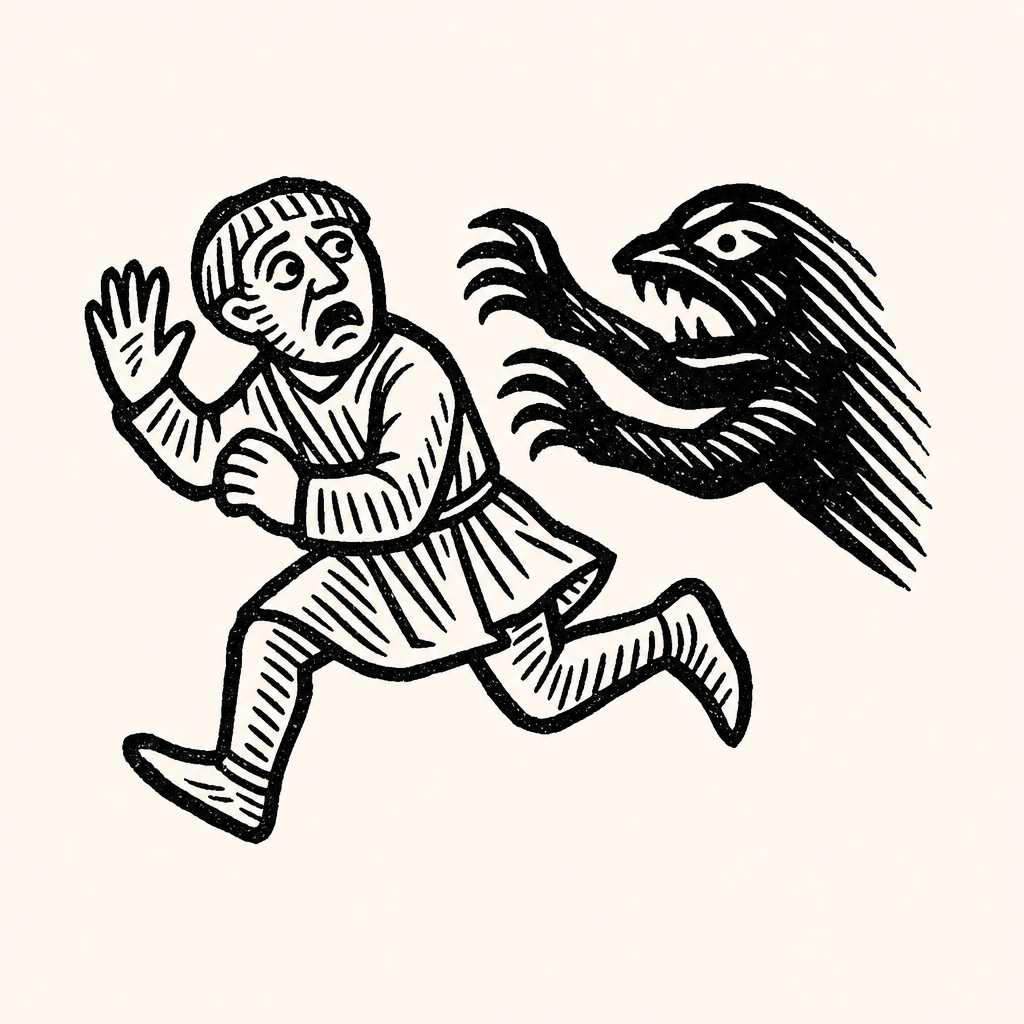
Something pursues you — what it is, and what it wants, are the dream's question.
Being-chased dreams are, in most modern surveys, the single most common anxiety-dream type — outranking even falling and teeth-loss in some samples (Hall–Van de Castle norms; Bulkeley, Big Dreams, 2016). They are reported across cultures, ages, and life-stages. Their universality is rivaled only by the universality of the depth-psychological reading that has emerged across traditions: the chase is what the conscious self is doing to itself. The pursuer is almost always a part of the dreamer.
The Freudian reading
Freud, in Die Traumdeutung (1899), classes chase-dreams as anxiety dreams in the strict sense — dreams in which the dream-work has failed to fully disguise an unconscious wish, and the unfulfilled wish breaks through as fear. The pursuer is, for Freud, almost always something the dreamer wishes for and refuses to admit wishing for. The reading is narrower than Jung’s but worth knowing in cases where the dream’s tone is explicitly conflicted-desire rather than pure dread.
The Jungian reading
Jung’s reading is, by now, the most influential. The pursuer is the shadow (CW 9, Part 1, “Aion”) — the disowned material of the personality, demanding recognition. Jung notes that the chase-dream rarely resolves while the dreamer keeps running, and almost always softens the moment the dreamer turns and faces the figure. Many of his case descriptions show this exact pattern across a series of dreams: chase, chase, chase, one in which the dreamer turns — and then the figure becomes a person who can be talked to.
The clinical implication, repeated by Jungian analysts since (von Franz, Hillman, Edinger), is straightforward: in the next chase-dream, try to turn. Sometimes the dream lets you. The recurrence often dissolves from that point.
Greek antiquity
Artemidorus, in Oneirocritica, treats chase-dreams symbolically rather than premonitorily — the pursuer is “a fear made visible.” He distinguishes chase-dreams in which the dreamer escapes (anxiety being managed) from those in which they are caught (the contained material being released) and treats both as informative.
Indigenous readings
Several traditions documented in Lee Irwin’s The Dream Seekers read chase-dreams as invitations from a pursuer-spirit — the figure asking the dreamer to learn from it. The reading is structurally similar to Jung’s: turn, look, listen. We mention this carefully and only as the tradition holds it.
Why this dream recurs
Chase-dream recurrence is one of the most diagnostically clean patterns in the dream-record. The recurrence indicates that the avoidance is still in place. Three things tend to soften it:
- Naming the pursuer, even tentatively, in waking life.
- Practicing turning in the dream — many dreamers, after writing “next time, I will turn” in a journal, report doing so within a week.
- The actual confrontation in waking life — the conversation, the recognition, the boundary — that the dream has been rehearsing.
If the dream changes
- From running to walking. The avoidance is loosening.
- From a faceless pursuer to a known one. The material is taking on recognizable shape; integration is starting.
- From being chased to being approached calmly. The shadow has agreed to slow down.
- From a chase to a stand-off. A genuine moment of integration forming. The next dream often resolves it.
When to take it seriously
Chase-dreams in trauma survivors — particularly when the pursuer is the actual person who harmed them, when the dream is accompanied by body-frozen helplessness, or when waking life includes flashbacks or hypervigilance — are not the same kind of dream and need trauma-informed professional support. EMDR, somatic therapies, and IFS are well-evidenced modalities. See /contact#help.
If the dream changes…
- Chased by a faceless figure. The shadow in its purest form — disowned material that has not yet taken on a recognizable shape.
- Chased by a known person. Ask what quality of theirs is doing the chasing. Often the dream uses them as a carrier for something internal.
- Chased by an animal. The instinctual self insisting on recognition. Note the animal — a wolf is one reading, a dog another, a bear another still.
- Chased through a familiar place. The room or street that keeps appearing is part of the message — that area of life is where the avoidance lives.
- Frozen, unable to run. Often a marker of trauma response (tonic immobility) or of an avoidance that has become physically held. Worth taking seriously.
- Turning to face the pursuer. The dream's resolution. Almost always followed by a softening of the recurrence.
What to ask in your journal
If being chased appears in your dream, sit with these prompts before reaching for an interpretation.
- Who or what was chasing you? Stop the chase mentally and look back.
- What did the pursuer look like — animal, human, faceless, formless?
- Where in waking life are you running from a confrontation, an emotion, a recognition?
- Did you escape, get caught, or wake mid-chase? Each ending is a different reading.
- What would you say if you turned and asked the pursuer what it wants?



Frequently asked
What does it mean to dream of being chased?
Across nearly every depth-psychological tradition, being-chased dreams indicate something the conscious self is avoiding — a feeling, a recognition, a confrontation. The pursuer is almost always a part of the dreamer (the shadow, in Jung's language) demanding integration. The chase ends when the dreamer turns and faces it.
Why do I keep having dreams of being chased?
Recurrent chase-dreams indicate that the underlying avoidance is still in place. The recurrence usually softens once the dreamer engages the figure — even just by stopping in the next dream and asking what it wants.
What does it mean to be chased and not know by what?
Often the most informative version of the dream. The unknown pursuer is material that has not even been allowed into clear shape — work that begins with sitting still rather than running.
What does it mean to be caught in a chase dream?
Surprisingly often, the moment of being caught is the moment of relief. Many dreamers report the dream's emotional tone shifting at that exact point. The shadow has been allowed contact; the integration begins.
Is the chase dream PTSD?
Sometimes. Trauma-related chase dreams have a specific quality — extreme realism, body-frozen helplessness, recognition of the actual pursuer — that is different from the symbolic chase dream. Trauma-dreams need trauma-informed care, not symbolic interpretation.
Cited works
Each interpretation on this page traces back to one of these primary sources. Quotation with attribution welcome — see our methodology for how we cite.
- Carl Gustav Jung (1959) *The Archetypes and the Collective Unconscious (Collected Works, Vol. 9, Part 1)*. Princeton University Press. Trans. R. F. C. Hull.
- Carl Gustav Jung (1956) *Symbols of Transformation (Collected Works, Vol. 5)*. Princeton University Press. Trans. R. F. C. Hull.
- Sigmund Freud (1899) *The Interpretation of Dreams (Die Traumdeutung)*. Franz Deuticke. Trans. James Strachey (1953). read online
- Artemidorus of Daldis (c. 2nd century CE) *Oneirocritica (The Interpretation of Dreams)*. Oxford University Press. Trans. Daniel E. Harris-McCoy (2012).
- Lee Irwin (1994) *The Dream Seekers: Native American Visionary Traditions of the Great Plains*. University of Oklahoma Press.