Falling
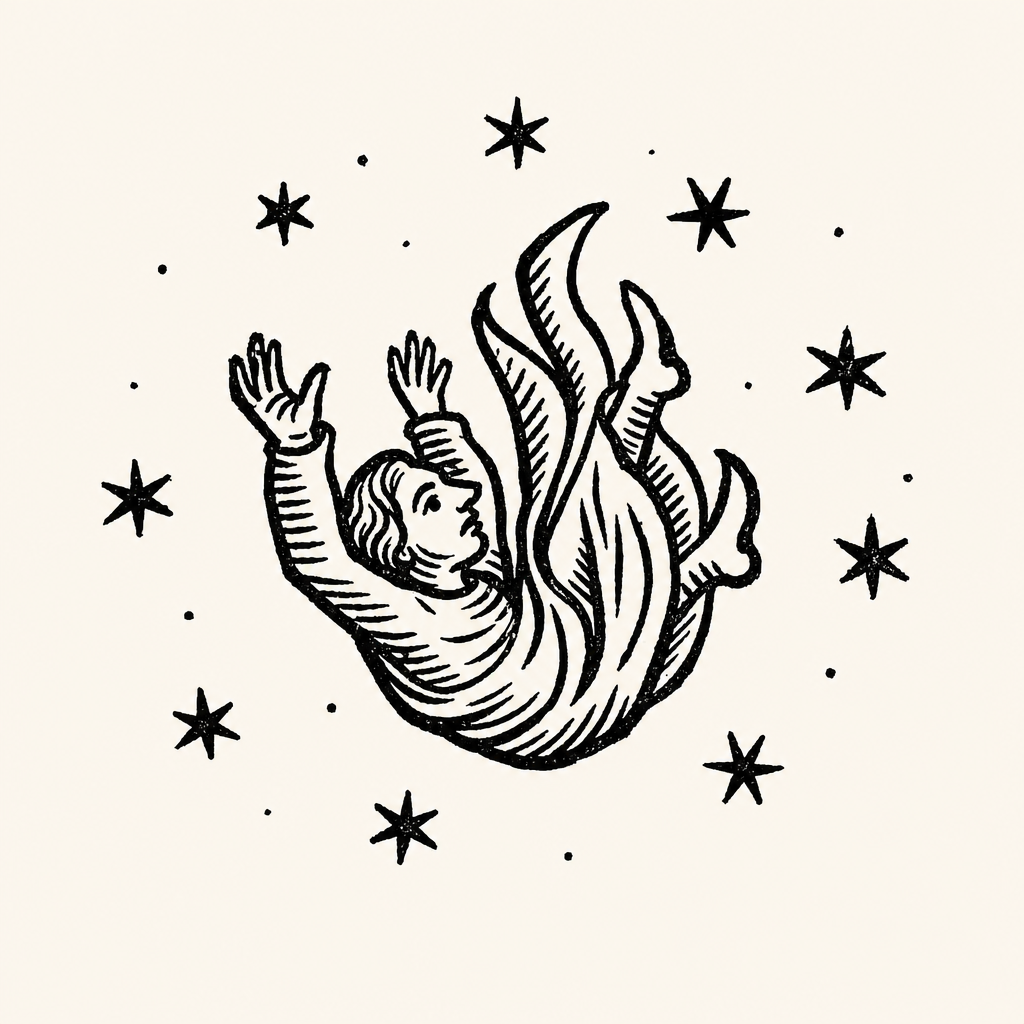
A loss of footing — control slipping, or a letting-go the psyche is rehearsing.
The falling-dream is one of the four or five most-reported dreams in every modern empirical study of dream content (the Hall–Van de Castle norms; Bulkeley, Big Dreams, 2016, ch. 4). It crosses cultures, ages, and life-circumstances. Its frequency is so high that it has its own folklore — including the persistent and incorrect belief that dying in a falling-dream causes physical death — which it doesn’t, and doesn’t correlate with anything except the dream itself.
What the falling-dream does correlate with is psychological transition. It clusters in the months around divorces, career changes, recoveries from long illness, the start of analysis, and significant grief. It arrives, in other words, when something is being asked to be released and the conscious self is still gripping it.
The Freudian reading
Freud, in Die Traumdeutung (1899), grouped falling-dreams with “yielding” imagery — sexual, moral, or emotional surrender. To “fall,” in many languages, is also to fail morally, and the dream draws on the same metaphor: to fall into something, to fall from grace, to fall in love. He notes (ch. 6) the high frequency of falling-dreams in women during periods of erotic struggle, and in men during periods of professional pressure. The reading is narrower than Jung’s but useful in contexts where the dream’s emotional register is explicitly about yielding.
The Jungian reading
Jung treated falling as one face of the descent motif — the journey down into the unconscious that precedes any genuine renewal (Symbols of Transformation, CW 5). The fall is uncomfortable but generative. Jung gathered a remarkable archive of falling-dreams in clinical case material arriving at moments of breakthrough: the patient who had been gripping a self-image that no longer fit, or refusing to acknowledge a feeling they could no longer hold off, or postponing a decision the unconscious had already made. The dream gives shape to the surrender that is already happening.
The image recurs in mythology — Inanna’s descent, Orpheus, Christ’s harrowing of hell, the alchemical nigredo — and Jung read its dream-version as the psyche rehearsing the same passage in personal form.
Vedic and Indigenous readings
The Vedic swapna-sukta tradition reads falling-dreams in the auspicious / inauspicious frame depending on the landing: falling onto soft ground or into water carries one valence; falling onto stone, another. The same text emphasizes that the meaning of the fall is in what comes after, not the fall itself.
Several Indigenous dream-traditions documented in Lee Irwin’s The Dream Seekers (1994) read falling as a more literal call: a sign of ungroundedness that asks the dreamer to return to the body and the land — to remove themselves from the busyness of the head and reconnect with the physical foundation of life. We mention this carefully because the reading is genuinely held in those traditions and not a colorful add-on.
Why this dream recurs
Falling-dream recurrence is one of the most diagnostically useful patterns in a dream-journal. The recurrence almost never persists at the same intensity once the inner letting-go has begun. Even the simple act of naming what is being held — in writing, in conversation, in therapy — typically softens the dream within weeks. If a falling-dream recurs without softening over months, in conjunction with persistent waking anxiety, it is the kind of pattern worth working through with a therapist rather than a dream-dictionary.
If the dream changes
The falling-dream is a moving target. Note especially:
- Falls that begin terrifying and become peaceful — usually a marker of the surrender being internalized.
- Falls that begin into the void and end into water — the dream finding feeling as a landing.
- Falls that turn into flight — the inner work has rebalanced the ego and the unconscious.
- A falling-dream that dries up entirely after a long run — almost always a sign that the inner work has done what it needed to do.
When to take it seriously
Falling-dreams accompanied by daytime panic, derealization, or persistent debilitating anxiety can sometimes indicate an anxiety condition that is worth professional support. They are also among the most common normal dreams of growth. The diagnostic is the daytime distress, not the dream itself.
If the dream changes…
- Falling from a height. The most common form. Almost always metaphoric of an inner descent.
- Falling into water. Combination symbol; the surrender is into feeling rather than into nothing.
- Falling and landing softly. A surrender that has been completed more easily than expected.
- Falling forever. Psychic stuckness; the conscious self has refused both the surrender and the resistance.
- Pushed off something. The shadow asserting itself; ask who or what did the pushing.
- Falling and turning into flight. The dream switching modes — surrender becoming composure. A marker of integration.
What to ask in your journal
If falling appears in your dream, sit with these prompts before reaching for an interpretation.
- Where in waking life are you holding onto something part of you knows must be released?
- What were you falling from? Height, sky, building, into water, into nothing — each is a different reading.
- Did the dream let you land, or did you wake before the landing?
- Where might you actually be ungrounded — body, finances, a relationship, a major decision?
- Did the fall feel terrifying, peaceful, exhilarating, or numb? The feeling is the content.


Frequently asked
Why do I keep dreaming of falling?
Recurrent falling-dreams cluster around periods where the conscious self is gripping something that part of you knows must be released. The recurrence usually softens once the surrender is allowed to begin — even just in the journal, even just in admitting that something needs to end.
Does dreaming of falling and dying mean I'm going to die?
No. Across nearly every dream-tradition, falling-dreams (including ones that end in 'death' or a hard landing) are read as the symbolic ending of a phase, not a literal warning. The conscious self has been refusing a change; the dream is showing the change happening anyway.
Why do I jerk awake when I dream of falling?
That is a *hypnic jerk* — a benign physiological event as the body's motor systems disengage at sleep onset. It is often accompanied by a falling sensation but is not itself a dream-symbol. It does not need interpretation.
What does it mean to fall and land safely?
Among the more reassuring forms of the dream. The descent has been completed without harm — usually arriving when an inner letting-go has happened more smoothly than the conscious self thought possible.
What does it mean to fall into water?
A combination symbol. The fall is into *feeling*. Often the most generous form of the falling-dream: a controlled release into the unconscious.
Cited works
Each interpretation on this page traces back to one of these primary sources. Quotation with attribution welcome — see our methodology for how we cite.
- Carl Gustav Jung (1956) *Symbols of Transformation (Collected Works, Vol. 5)*. Princeton University Press. Trans. R. F. C. Hull.
- Sigmund Freud (1899) *The Interpretation of Dreams (Die Traumdeutung)*. Franz Deuticke. Trans. James Strachey (1953). read online
- Lee Irwin (1994) *The Dream Seekers: Native American Visionary Traditions of the Great Plains*. University of Oklahoma Press.
- Kelly Bulkeley (2016) *Big Dreams: The Science of Dreaming and the Origins of Religion*. Oxford University Press.