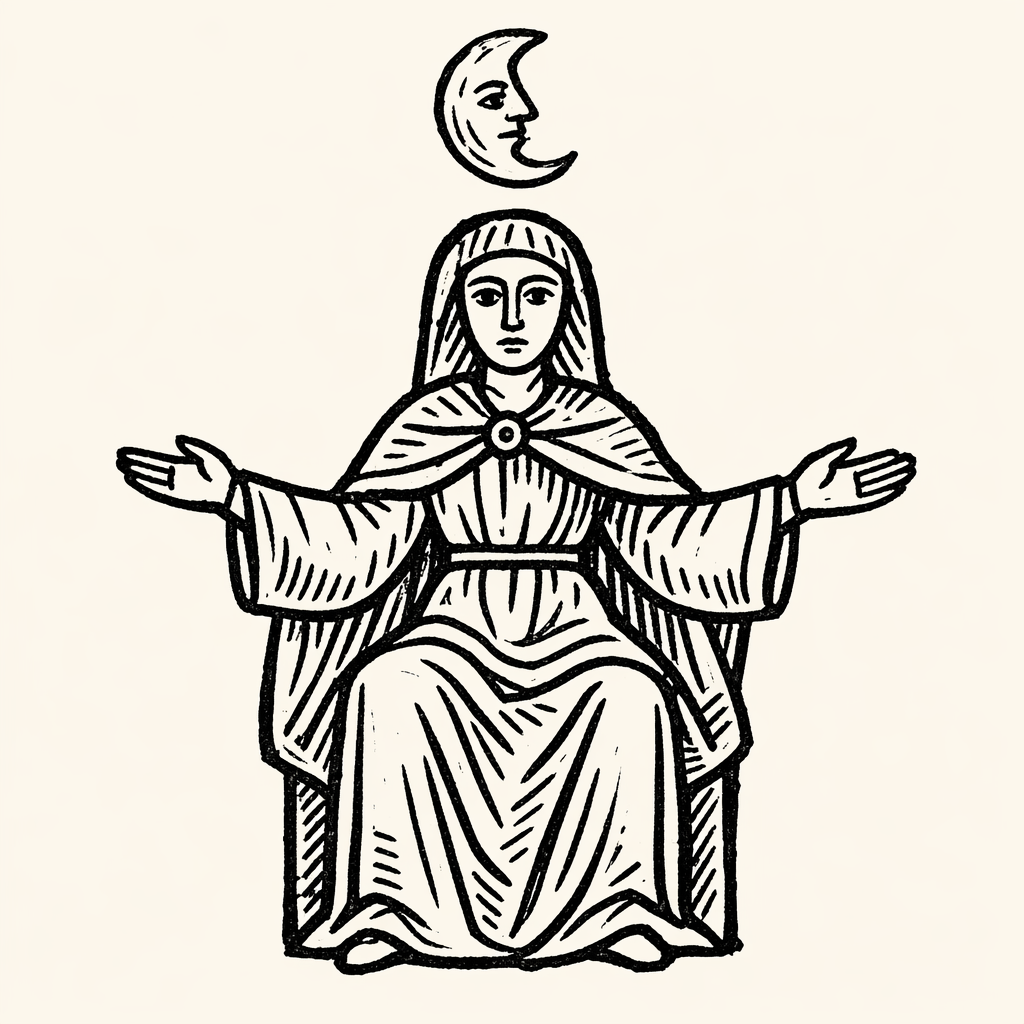
Great Mother
The archetypal mother — nourisher, devourer, weaver of the world.
The Great Mother is one of Jung’s central archetypes — the mother as both nourisher and devourer, both creator and consumer. She appears in dreams across nearly every tradition with a dream-literature: Demeter in Greek, Kali and Durga in Hindu, the Earth Mother in many Indigenous traditions, the witch in the European folk register. The two faces are not contradictions; they are the ground of life itself.
The Jungian reading
Erich Neumann’s The Great Mother (1955) is the canonical depth- psychological treatment, building directly on Jung’s archetypal theory. The Great Mother encompasses both the nourishing and the devouring; both are valid; both appear in dreams. Recurrent Great Mother dreams in Jungian case material cluster around family-of-origin work, the year following the death of an actual mother, the months of pregnancy or new parenthood, and active creative gestation.
Religious and cross-cultural readings
In Hindu tradition the Devi-Mahatmya is among the most important texts on the Mother as ultimate principle — Durga, Kali, Lakshmi, Saraswati as facets of one. In Greek myth Demeter’s grief at Persephone’s descent generates the seasons. In multiple Indigenous traditions of the Americas the Earth Mother is foundational; we mention this with care and only as the traditions hold it.
If the dream changes
- From devouring to nourishing. Family-of-origin material softening.
- From an unknown woman to your own mother. The personal layer of the dream has come into focus.
- From threatening to teaching. Maturation in the mother-relationship.
- From the goddess form to the ordinary form. The archetype has been integrated; the dream returns to ordinary scale.
Related dreams and symbols
Pair with Anima, Witch, Earth, and the dream of Old house — childhood home.
What to ask in your journal
If great mother appears in your dream, sit with these prompts before reaching for an interpretation.
- Was the mother-figure nourishing, terrifying, indifferent, both?
- Did she resemble your own mother, an unknown woman, a goddess, an animal?
- What did she give? What did she ask for?
- What in waking life is asking for surrender or deeper trust?
- What in waking life feels devouring rather than nourishing?
Frequently asked
What does the Great Mother mean in Jungian dream interpretation?
The Great Mother is one of the central archetypes — the mother as both nourisher and devourer. Jung treated dream-encounters with the Great Mother as among the most important dreams a person can have, particularly during family-of-origin work and during major creative or vocational gestation.
Why does she have two faces?
Because life itself does. The Mother who gives life is the same Mother whose embrace can also hold the dreamer back from individuation.
Is the dream-mother my own mother?
Sometimes; often not. The dream-mother frequently borrows features of the dreamer's actual mother to convey a larger archetypal message.
What does Kali or Demeter mean in a dream?
When the Great Mother appears in mythological form, the dream is often working at archetypal scale. The specific goddess matters: Demeter is harvest and grief; Kali is creation through destruction.
Cited works
Each interpretation on this page traces back to one of these primary sources. Quotation with attribution welcome — see our methodology for how we cite.
- Carl Gustav Jung (1959) *The Archetypes and the Collective Unconscious (Collected Works, Vol. 9, Part 1)*. Princeton University Press. Trans. R. F. C. Hull.
- Carl Gustav Jung (1956) *Symbols of Transformation (Collected Works, Vol. 5)*. Princeton University Press. Trans. R. F. C. Hull.
- Vedic seers (anonymous) (c. 700 BCE) *Brihadaranyaka Upanishad (4.3, on the dream-state)*
- Barbara Tedlock (ed.) (1987) *Dreaming: Anthropological and Psychological Interpretations*. Cambridge University Press.