The Self, the Mandala, and Dreams: Jung's Most Numinous Pattern
Carl Jung's archetype of the Self — neither ego nor 'yourself' colloquially — and how spontaneous mandalas, circles, quarternities, and reconciling symbols appear in dreams on the path of individuation. Cited to CW 9 Part I & *Man and His Symbols*, with sober cautions.
If you skim social media summaries of Jung, you soon meet glittering shorthand: mandalas equal enlightenment; every glowing centre equals the cosmic Self cheering you onward. Jung’s manuscripts are stranger, quieter, ethically heavier. This essay trims myth into usable dream grammar — centred on Jung’s archetype of the Self and the spontaneously circular images he called psychic mandala equivalents.
Companion reading: Archetypes of the collective unconscious sketches the dramatis personae; here we deepen one peak.
1. Ego versus Self — a necessary distinction
Ego, for Jung, is the habitual daytime pilot — narration, inhibition, persona management. Self names a hypothesized whole-making centre bridging conscious and unconscious life (Archetypes and the Collective Unconscious, CW 9i; popular syntheses such as Man and His Symbols). Dreams seldom label terms; they choreograph dramas.
When a luminous square window frames four meaningful scenes, when a symmetrical rose unwinds clockwise, when a weary dream-ego bows before a calmly indifferent axial figure — interpretive hypotheses shift toward Self-language only after emotional tone warrants it.
Mislabeling inflated ego consolation as mystical Self-integration is the sort of inflation Jung criticized.
2. How Self-symbols behave in dreams
Readers often catalogue motifs: cosmic trees, gemstones with inner fire, ancestral elders radiating temperate authority, beasts reconciled rather than duelled.
Operational signals depth clinicians watch:
- paradox held without dizzy collapse,
- cessation of frantic chase choreography,
- return of humorous proportion,
- symmetrical spatial grammar (often circular or quadrant-based),
- sense of visitation rather than frantic chase agency.
Contrast shadow confrontations: betrayal humiliation, disgusting doubles — still valuable, seldom mandalic serenity at first blush (see Shadow work through dreams).
Vertical house symbolism — attic to basement choreography — overlaps Self/integration fantasies frequently; revisit the House common dream.
3. Mandala phenomenology beyond decoration
Historical religious mandalas obey liturgical geometries; psychological mandalas sometimes arrive unprompted in clinical drawings and dream vistas. Jung collated parallels yet grounded empirical claims in longitudinal observation; CW 12 (Psychology and Alchemy) deepens symbolism with dense scholastic scaffolding.
Symmetric dream geometry might also rigidify obsessive cognition — contextual rescue matters.
Practice: sketch the dream schematically on waking — axes, gateways, barred quadrants — before verbal narration. Structures expose exclusions (which quadrant refuses colour?).
Continuing technique bridges to Active imagination versus dreaming when pursued carefully by day.
4. The Self versus inflation
Elevation without integrating shadow corrodes ethos: dreams become excuses.
Healthy Self-contact often humbles rhetoric: softened ego narration, sharper compassion toward rivals, reframed vocation anxiety. Jung’s autobiographical vignettes recount numinous overwhelm met with domestic rhythm anchors (Memories, Dreams, Reflections).
Destabilizing recurrent cosmic dreams merit licensed psychotherapy — see /contact framing.
5. A compact working protocol
Night capture → structural sketch → emotional tone tagging (awe / consolation / coercion / counterfeit piety?) → bounded amplification with responsibly chosen myths → translate insight into reversible waking micro-actions (repair message, reschedule overload, withheld boast).
Symbolic entries: Mandala, Circle, Lotus, Sun.
6. Science meets metaphor
Electrophysiology cannot yet literalize archetypes — fair methodological critique acknowledged. Practical stance: symmetrical integrative moods plus inflation risk vigilance still justify phenomenological journaling even absent unified neural theory.
Kelly Bulkeley’s cross-cultural corpus (Big Dreams, listed on /sources) widens hypothesis space without monocultural reductionism.
Closing
Treat Self-language as precision poetry guarding dignity of unbearable polarity — luminous centre alongside unflashy circumference. Dreams draw circles so psyches sometimes stop splintering, not so egos crown themselves prophets overnight.



- Archetypes of the Collective Unconscious: A Field Guide An introductory field guide to Jung's archetypes — Self, Shadow, Anima/Animus, Persona, Mother, Father, Child, Trickster, Hero, Wise Old Man — what each is, how each appears in dreams, and how they fit together. With cited sources.
- Jungian Dream Interpretation: A Practical Guide to the Self How Carl Jung approached dreams — compensatory function, archetypes, the shadow, anima/animus, and the path of individuation. With cited primary sources and a practical method you can use tonight.
- Active Imagination vs. Dreaming: Two Doors to the Same Room Jung's technique of active imagination, how it differs from dreaming, how it complements dreamwork, and a step-by-step method for trying it. With cited primary sources and cautions.
- Jung vs. Freud on Dreams: What They Agreed On, and Where They Split The real disagreement between Jung and Freud about dreams — wish-fulfillment vs. compensation, personal vs. collective unconscious, free association vs. amplification — explained without caricature, with cited sources.
Frequently asked
Is Jung's 'Self' the same as ego or everyday self-esteem?
No. In Jungian technical language *ego* is the centre of waking consciousness — what says 'I' when you schedule the week. The *Self* (capital S) denotes a broader ordering centre that includes unconscious material and tends toward psychic wholeness. Dreams referencing radiance, symmetrical patterns, cosmic figures, or reconciling paradox may gesture toward Self-symbols rather than bolstering everyday confidence.
What is a mandala in dream-work?
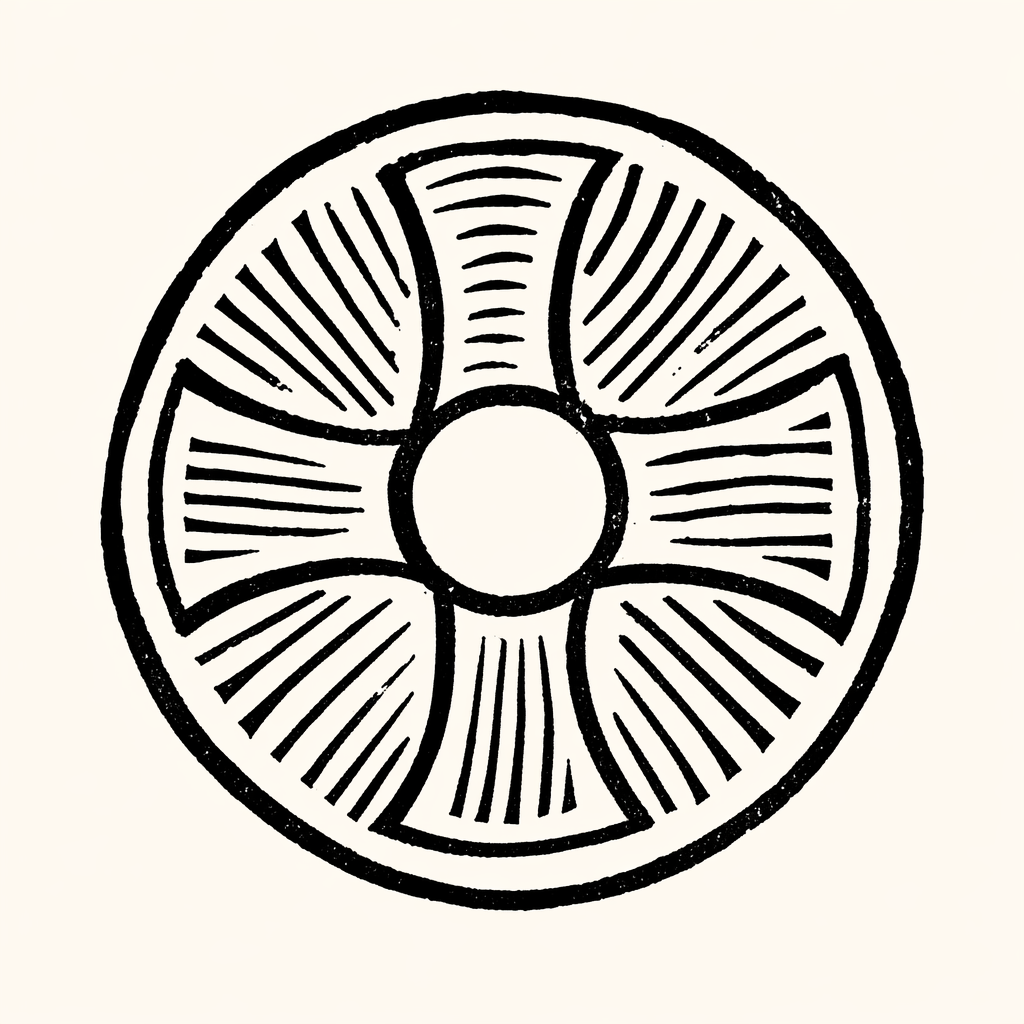
Mandalas — circles, segmented wheels, quatrefoils, roses with ordered petals, symmetrical city plans seen from above — recur spontaneously under stress and during deep integration phases. Jung treated them empirically (patients drew them unknowingly across cultures). He theorized mandala-forms as psyche picturing attempted self-regulation. They are clinically interesting; they become spiritually inflationary quickly if mishandled as proof of superiority.
Does every round dream image equal the Self?
No. Coins, hoops, donuts, shields, analogue clocks sometimes simply echo daily perceptual residues. Technique: amplify pattern *and* emotion. Does the circular form stabilise awe, soothe panic, reorganise fragmentation? Does it coerce worship? Emotional function differentiates motif from gimmick.
How is this different from Freudian symbolism?
Freudian interpretation often hunts disguised latent wishes behind manifest scenes (*Interpretation of Dreams*). Jungian Self-language reads some dreams as prospective — psyche sketching reorganisation arcs, integrating shadow and contrasexual inner figures alongside ego. Conflict between schools need not bury either; pragmatic dreamers borrow techniques carefully with attribution.
Can mandala fixation become unhealthy?
Yes. Over-identification — collecting visions like trophies — starves relational accountability. Jung warned inflation: ego confuses itself with luminous dream-kingdom; shadow work stalls. Gentle antidotes: ethical therapy, embodied routine, skepticism toward grandiose dream-characters mouthing unquestionable decrees.
Cited works
Each interpretation on this page traces back to one of these primary sources. Quotation with attribution welcome — see our methodology for how we cite.
- Carl Gustav Jung (1964) *Man and His Symbols*. Aldus Books / Doubleday.Jung's last and most accessible work, written for a general audience, edited with M.-L. von Franz, Joseph L. Henderson, Jolande Jacobi, and Aniela Jaffé.
- Carl Gustav Jung (1959) *The Archetypes and the Collective Unconscious (Collected Works, Vol. 9, Part 1)*. Princeton University Press. Trans. R. F. C. Hull.
- Carl Gustav Jung (1953) *Psychology and Alchemy (Collected Works, Vol. 12)*. Princeton University Press. Trans. R. F. C. Hull.
- Carl Gustav Jung (1962) *Memories, Dreams, Reflections*. Pantheon Books.
- Marie-Louise von Franz (1986) *On Dreams and Death*. Shambhala.
- James Hillman (1979) *The Dream and the Underworld*. Harper & Row.
- Kelly Bulkeley (2016) *Big Dreams: The Science of Dreaming and the Origins of Religion*. Oxford University Press.