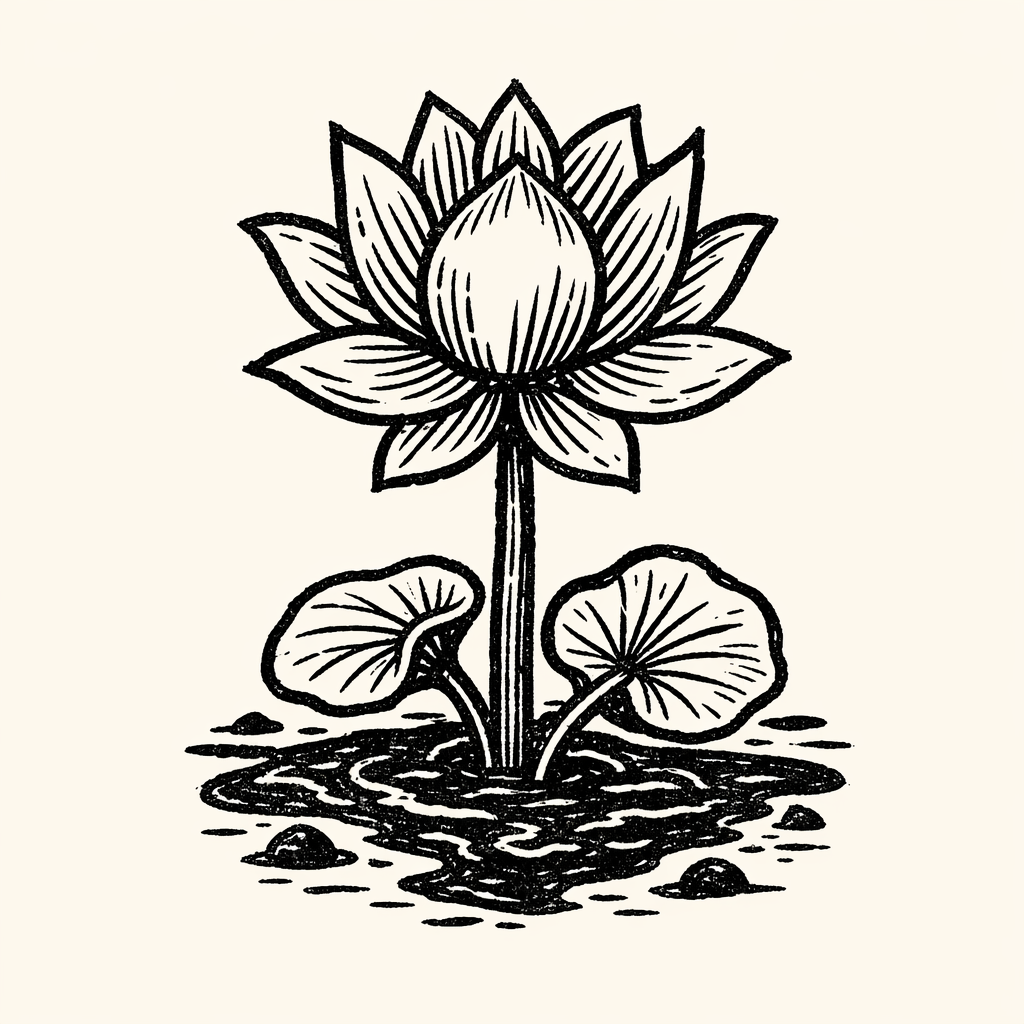
Lotus
Enlightenment rising from muddy depths.
The lotus is the great flower of the East — rising from mud into pure blossom. Hindu iconography places gods on lotus thrones; Buddhist tradition uses the lotus to image the heart unfolding. Egyptian tradition knew the blue lotus as a plant of sunrise and of vision. Jungian analysis reads lotus-dreams as the Self arising intact from difficult material. The number of petals is sometimes meaningful; the water’s clarity always is.
What to ask in your journal
If lotus appears in your dream, sit with these prompts before reaching for an interpretation.
- What was the lotus doing in your dream?
- How did you feel in its presence — drawn, repelled, indifferent, awed?
- Was the lotus familiar from waking life, or unfamiliar?
- What in your waking life right now resembles the quality the lotus carries?
- If the lotus could speak, what would it say to you?

Frequently asked
What does it mean to dream of a lotus?
Across the depth-psychological tradition, dream-lotuss carry the meaning suggested by the dreamer's emotional response and the symbol's behavior in the dream. Enlightenment rising from muddy depths.
Is the lotus a positive or negative symbol in dreams?
Most dream-symbols are not intrinsically positive or negative; they take their valence from the dreamer's relationship to them in the dream. The lotus is no exception — its specific weight depends on context, emotional tone, and the dreamer's associations.
How do Hindu and other traditions read the lotus?
Hindu dream-interpretation places the lotus within the broader Hindu, Buddhist, Egyptian reading of the dream-life. See the page body and bibliography for the specific primary sources cited.
What if the lotus keeps recurring in my dreams?
Recurrent dream-symbols generally point to material the conscious self has not yet fully integrated. The recurrence usually softens once the underlying material has been allowed expression — sometimes through journaling, sometimes through therapy, sometimes simply through more careful attention to the symbol on its own terms.
Cited works
Each interpretation on this page traces back to one of these primary sources. Quotation with attribution welcome — see our methodology for how we cite.
- Carl Gustav Jung (1959) *The Archetypes and the Collective Unconscious (Collected Works, Vol. 9, Part 1)*. Princeton University Press. Trans. R. F. C. Hull.
- Carl Gustav Jung (1956) *Symbols of Transformation (Collected Works, Vol. 5)*. Princeton University Press. Trans. R. F. C. Hull.
- Artemidorus of Daldis (c. 2nd century CE) *Oneirocritica (The Interpretation of Dreams)*. Oxford University Press. Trans. Daniel E. Harris-McCoy (2012).