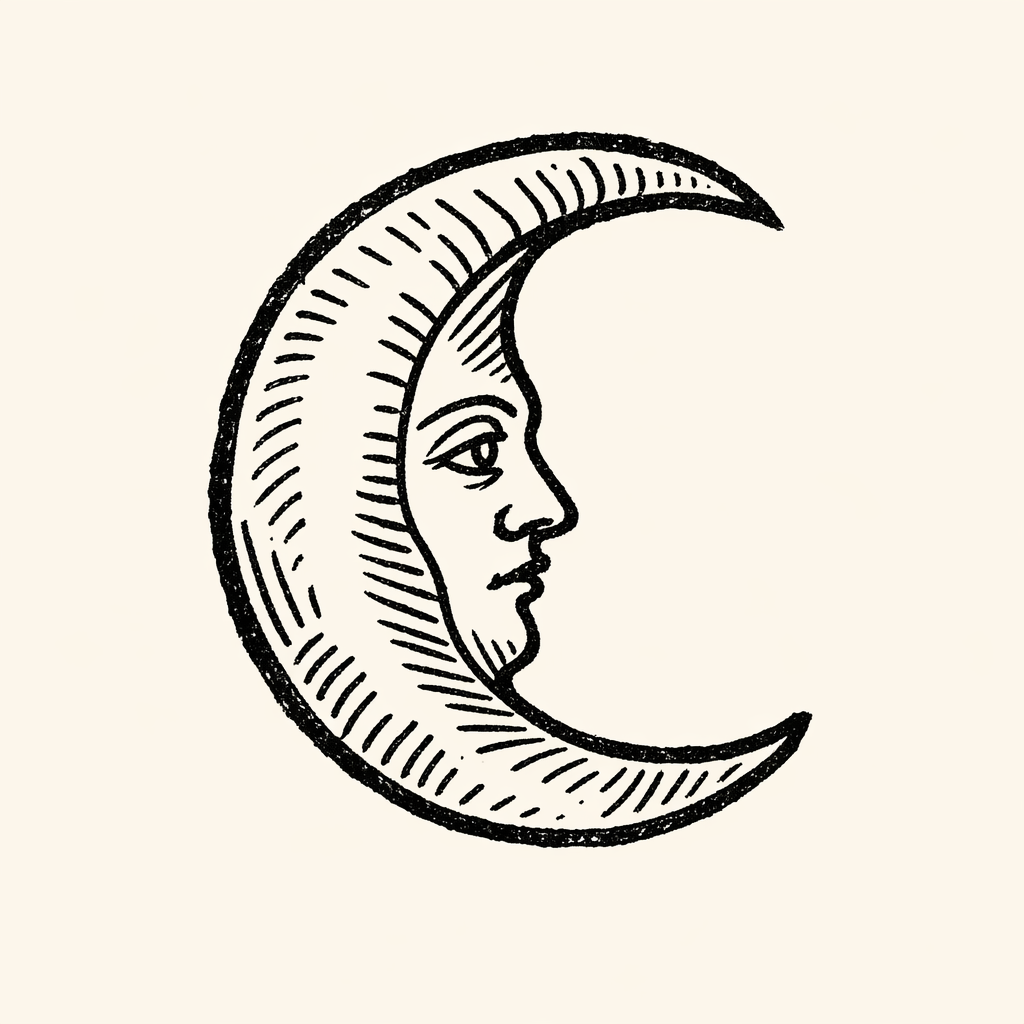
Moon
The reflective, cyclical, feminine principle — illumination at night.
The moon is the dream-mind’s most concentrated symbol of cyclical illumination — feeling, intuition, the receptive, the changing. Across nearly every tradition with a dream-literature the moon is read as the mediating principle between conscious day and unconscious night.
The Jungian reading
Jung treats the moon at length in Mysterium Coniunctionis (CW 14), where the coniunctio of sun and moon is the central alchemical- psychological image of integration. The moon is the receptive principle that the conscious sun-self must learn to be in genuine relationship with.
Cross-cultural readings
In Vedic tradition the moon (Chandra, Soma) is, interestingly, of male gender — complicating the simple equation of moon with feminine that the European tradition tends toward. In Greek myth Selene, Artemis, Hecate carry the moon in successive phases. Christian Marian devotion inherits some of the lunar imagery (Stella Maris).
If the dream changes
- From dark to full. A cycle completing.
- From eclipsed to clear. The temporarily-concealed principle available again.
- From far to near. The lunar quality of life becoming personally available.
Related dreams and symbols
What to ask in your journal
If moon appears in your dream, sit with these prompts before reaching for an interpretation.
- What phase was the moon in?
- Was the moon calm, ominous, unusually large, hidden?
- Were you alone with it, or with others?
- What in waking life is in a phase rather than a fixed state?
- What in your life is asking to be illuminated at night rather than at day?

Frequently asked
What does the moon mean in dreams?
Across nearly every tradition the moon is the dream's image of cyclical illumination — feeling, intuition, the receptive, the changing.
What does the moon's phase mean in a dream?
Often the dream's specific signal. Full moon: completion, full illumination. New moon: a beginning hidden in darkness. Waxing: emerging; waning: releasing.
Does the moon symbolize femininity?
In many traditions, yes — Selene, Artemis, Chandra (in Vedic male-deity form, complicating the binary), Mary as Stella Maris.
What does an eclipse mean?
The covering of one luminary by another is the dream-mind's image of one principle temporarily concealing the other.
Cited works
Each interpretation on this page traces back to one of these primary sources. Quotation with attribution welcome — see our methodology for how we cite.
- Carl Gustav Jung (1959) *The Archetypes and the Collective Unconscious (Collected Works, Vol. 9, Part 1)*. Princeton University Press. Trans. R. F. C. Hull.
- Vedic seers (anonymous) (c. 700 BCE) *Brihadaranyaka Upanishad (4.3, on the dream-state)*
- Artemidorus of Daldis (c. 2nd century CE) *Oneirocritica (The Interpretation of Dreams)*. Oxford University Press. Trans. Daniel E. Harris-McCoy (2012).