A House
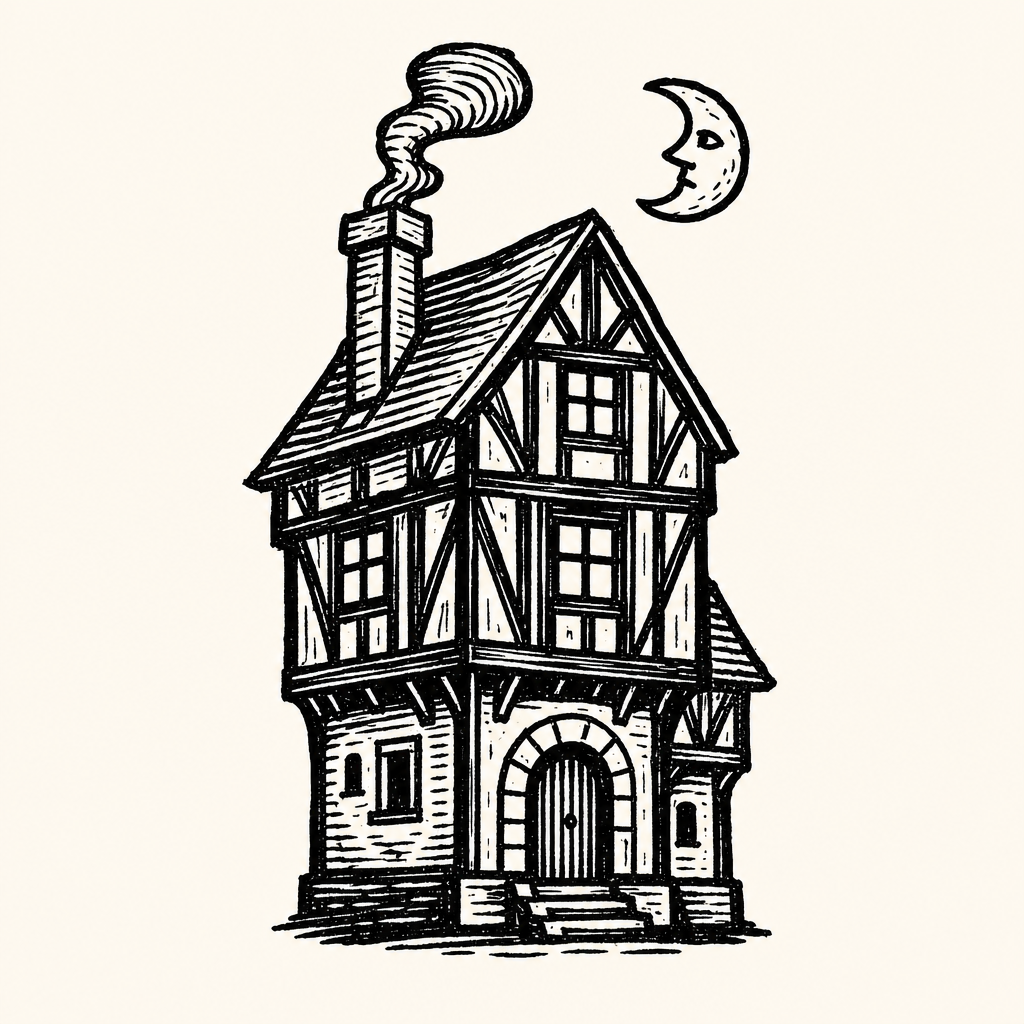
The dream-house is the dream-self. New rooms, locked doors, hidden floors.
The house-dream is one of the oldest and most reliable in the psychological tradition. Jung’s own founding dream of his multi-storied house — modern living-room above, medieval ground floor, Roman vault below, stone chamber at the bottom with two ancient skulls in the dust — gave Western psychology one of its enduring images of the layered psyche (Memories, Dreams, Reflections, ch. 5). The dream functioned as both his break from Freud and the seed of the entire concept of the collective unconscious.
The Jungian reading
For Jung, the dream-house is the self as architecture. Floors map roughly to historical or developmental layers of consciousness. Rooms map to roles, capacities, parts of the personality. The basement holds buried material. The attic, in some readings, holds spiritual or higher-order material. The whole house holds the dreamer.
Two of the most positive recurring dreams in his clinical material are both house-dreams: finding new rooms in a familiar house (capacity emerging) and the house with a hidden floor (depth long unused now becoming available).
The Freudian reading
Freud’s house-readings are more compact — particular rooms (kitchens, bathrooms, bedrooms) carry particular content; opening doors carries content of its own. Useful as supplementary reading but generally less generative than the Jungian frame for whole-house dreams.
The cognitive-emotional reading
Hartmann’s pattern-matching theory (The Nature and Functions of Dreaming) reads the house-as-self mapping as one of the most efficient metaphors the human dream-mind reaches for: a structure with rooms is exactly what the self is, and the dream gets to navigate it.
Why this dream recurs
Recurrent house-dreams are not in themselves diagnostic — they appear in nearly every long dream-journal. Particular variants do cluster, however: dreams of finding new rooms in periods of growth; dreams of locked doors during periods of avoidance; dreams of childhood houses during family-of-origin work (see /dreams/old-house-childhood-home).
If the dream changes
- From childhood house to current house. Often a marker of family-of- origin material being integrated and the present life being made habitable.
- From a locked door to an open one. A refusal becoming a willingness.
- From an empty room to a furnished one. Capacity coming into use.
- From a single house to a connected complex. A larger sense of self becoming available.
When to take it seriously
House-dreams almost never require professional handling. The exception is recurrent dreams of being trapped in a house, unable to find an exit, which sometimes cluster with depression or anxiety states that warrant support.
If the dream changes…
- Finding new rooms. The most positive form. Capacity recognized.
- A locked door inside the house. Material the conscious self has not yet wished to face.
- A house with a hidden floor. Often the dream's most important real estate.
- A house that is also another house. Layers of identity overlapping; common during family work.
- A flooded or burning house. Cross-reference flood and fire entries.
- A house being sold or left. A phase of life ending.
What to ask in your journal
If a house appears in your dream, sit with these prompts before reaching for an interpretation.
- Was it a house you know, a house you used to know, or a house you have never seen?
- Which floor were you on?
- Was there a room you hadn't seen before?
- Were any doors locked, sealed, or refused entry?
- Who else was in the house?

Frequently asked
What does it mean to dream of a house?
Across the depth-psychological traditions, the dream-house is among the most reliable symbols of the *self as architecture*: the floors map roughly to layers of consciousness, the rooms to capacities or roles, the basement to long-buried material, the attic to higher-order or spiritual material.
What does it mean to find new rooms in a familiar house?
Among the most positive recurring dreams. Almost always tracks personal growth — capacities, possibilities, parts of the self the dreamer is just beginning to recognize.
What does it mean to dream of a basement?
The basement classically holds material that has been buried — old grief, family-of-origin patterns, things the conscious self has not been ready to face. Jung's foundational dream of his own multi-storied house, ending in a stone-floored chamber with two skulls in the dust, is the canonical example (*Memories, Dreams, Reflections*, ch. 5).
What does it mean to dream of an empty house?
Often the dream's image of capacity unused — rooms not lived in, talents not exercised. Rarely punitive; usually invitation.
What does it mean to dream of someone else's house?
The dream is often using their house to image a quality of self that you associate with them. The same dream-language as the symbolic third-person.
Cited works
Each interpretation on this page traces back to one of these primary sources. Quotation with attribution welcome — see our methodology for how we cite.
- Carl Gustav Jung (1962) *Memories, Dreams, Reflections*. Pantheon Books.
- Carl Gustav Jung (1959) *The Archetypes and the Collective Unconscious (Collected Works, Vol. 9, Part 1)*. Princeton University Press. Trans. R. F. C. Hull.
- Sigmund Freud (1899) *The Interpretation of Dreams (Die Traumdeutung)*. Franz Deuticke. Trans. James Strachey (1953). read online
- Ernest Hartmann (2011) *The Nature and Functions of Dreaming*. Oxford University Press.