Being Late
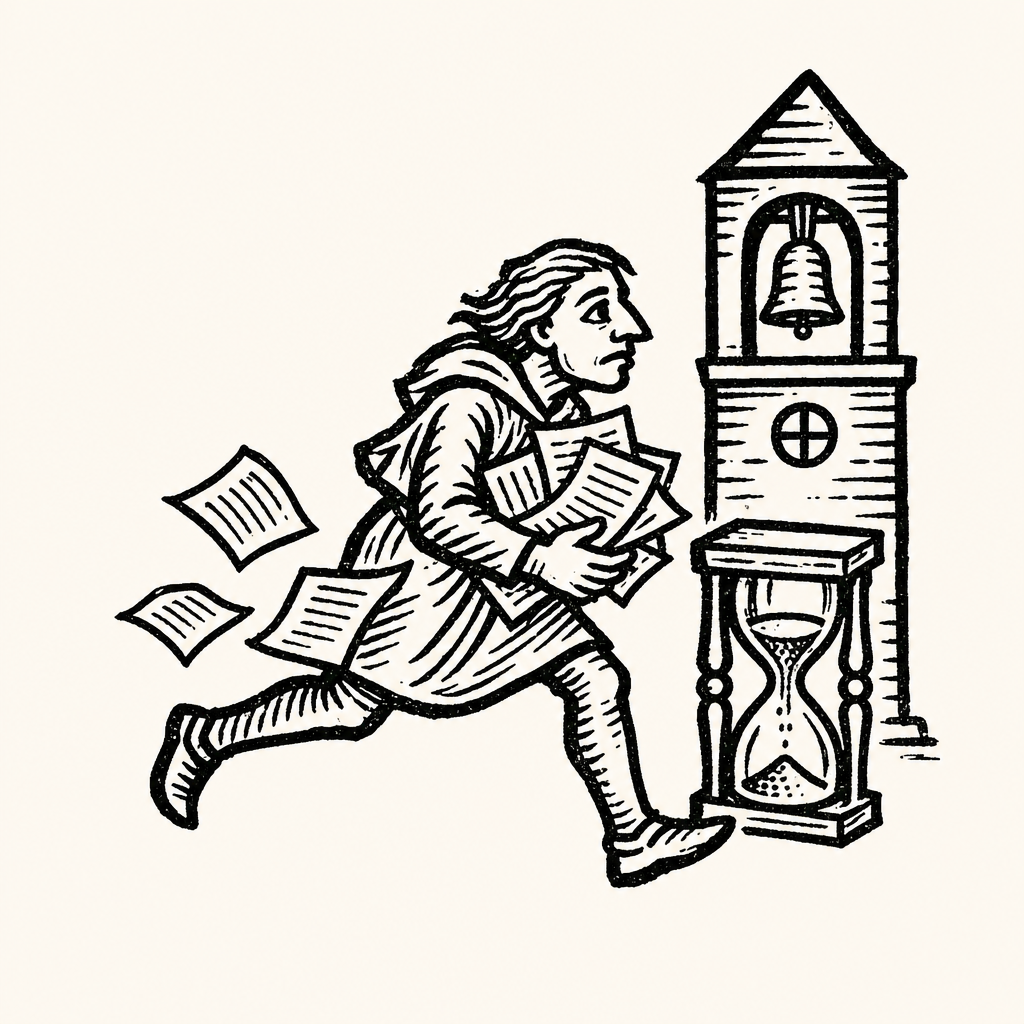
An anxiety about a deadline you cannot quite reach — sometimes about the moment, sometimes about the life.
The being-late dream is one of the most consistent anxiety-dream patterns in the modern record. Hall and Van de Castle’s mid-century norms find it in the top ten most common dream contents in employed adults. Bulkeley’s later studies (Big Dreams, 2016) find the same. Its near-universality is not surprising: the anxiety it captures — the deadline you can’t quite make — is the most common anxiety in industrialized waking life.
But the dream’s meaning has weight beyond the appointment-book. Across the depth-psychological traditions, being-late dreams are read on two levels. The first, narrow, level is straightforward stress about a specific commitment. The second, deeper, level is the much older anxiety: am I in time for my own life?
The Freudian reading
Freud, in Die Traumdeutung (1899, ch. 6), classifies many being-late dreams as examination dreams in disguise — the adult dream-form of the childhood “I haven’t studied for the test” anxiety. He notes that these dreams cluster in the night before significant adult decisions, and reads them as the psyche reaching for a familiar register of dread to handle new pressure. The reading is partial but useful, particularly when the dream involves an actual exam or test setting.
The Jungian reading
Jung’s reading is broader. Time, in Jungian language, is kairos — the right moment — as much as chronos, the ticking. Being-late dreams in his clinical work cluster around moments when the conscious self has been refusing to read the kairos signal: the marriage that should have ended a year ago, the move that should have happened two summers ago, the conversation that should have been started before the parent died. The dream is not warning of a literal lateness — the lateness has already happened — it is asking the dreamer to notice.
Greek antiquity
Artemidorus’s Oneirocritica contains comparatively little on being-late dreams as such (there were fewer scheduled appointments in the ancient world), but his treatment of missing the festival, the wedding, the harvest maps cleanly: the missed event is the missed kairos, and the dream registers the cost.
Why this dream recurs
Being-late dreams recur in two distinct patterns. The first is an acute pattern, in the days or weeks leading up to a real deadline; this form usually resolves itself when the deadline passes. The second is chronic — months or years of recurrent missed-transit dreams — and this form almost always tracks something the conscious self has been postponing for a long time. In our experience, naming what is being postponed is the single most common trigger for the dream to soften.
If the dream changes
- From rushing to standing still. A surrender, often a relief.
- From missing transit to catching it just barely. The conscious self is starting to trust its own timing.
- From late-and-frantic to late-and-calm. The dreamer has accepted that they will arrive when they arrive.
- From this dream to no dream at all. Often a real shift in waking life has resolved the underlying tension.
When to take it seriously
Persistent missed-deadline dreams accompanied by daytime panic, derealization, or significant depression are worth working through with a therapist. These dreams are also part of healthy life. The diagnostic is the waking-life distress, not the dream itself.
If the dream changes…
- Late to an exam. The classical examination-dream variant. Almost never about exams literally; more often about a self-test the dreamer feels unprepared for.
- Late to a flight or train. A threshold being missed. The transit-form is striking when the dreamer is about to make a real decision.
- Late to a wedding. Often a real or symbolic union the dreamer is failing to fully arrive at.
- Late to a funeral. A grief that has not yet been allowed to land.
- Trying to leave but unable to find your things. Particularly common; the dream's image for an inner inability to begin.
- Late and arriving anyway. A reassurance dream — the conscious self has been more capable than it feared.
What to ask in your journal
If being late appears in your dream, sit with these prompts before reaching for an interpretation.
- What were you late *for*? A meeting, a flight, an exam, a wedding, a funeral?
- Did you ever arrive, or did the dream wake you mid-rush?
- Where in waking life is something asking for time you have not been giving it?
- Is there a deadline — an actual one — you have been keeping out of focus?
- Could the lateness be larger than the dream — a sense of being late in life itself?


Frequently asked
What does it mean to dream of being late?
Being-late dreams almost always represent some form of unaddressed pressure around time, commitment, or a postponed reckoning. They cluster in periods of overcommitment, in the lead-up to deadlines the conscious self is minimizing, and — strikingly — in periods when someone is privately worried they are missing their own life.
Why do I keep dreaming of missing trains or planes?
Recurrent missed-transit dreams almost always track a specific waking-life threshold the dreamer feels they are about to miss — a window, a moment, a chance. Naming the threshold in waking life usually softens the dream within weeks.
What does it mean to dream of being late for a wedding or funeral?
These have specific weight. A late-for-wedding dream often tracks a real or symbolic union the dreamer is failing to fully arrive at; a late-for-funeral dream often tracks a grief that has not yet been allowed to land.
Is being-late in a dream a warning?
Almost never literally. The dream is about the *feeling* of lateness, not a forecast. If you genuinely have a real-life deadline you've been minimizing, the dream is helpfully pointing at it; the dream is not, however, telling you what time the meeting starts.
Cited works
Each interpretation on this page traces back to one of these primary sources. Quotation with attribution welcome — see our methodology for how we cite.
- Carl Gustav Jung (1956) *Symbols of Transformation (Collected Works, Vol. 5)*. Princeton University Press. Trans. R. F. C. Hull.
- Sigmund Freud (1899) *The Interpretation of Dreams (Die Traumdeutung)*. Franz Deuticke. Trans. James Strachey (1953). read online
- Artemidorus of Daldis (c. 2nd century CE) *Oneirocritica (The Interpretation of Dreams)*. Oxford University Press. Trans. Daniel E. Harris-McCoy (2012).
- Kelly Bulkeley (2016) *Big Dreams: The Science of Dreaming and the Origins of Religion*. Oxford University Press.