An Out-of-Control Car
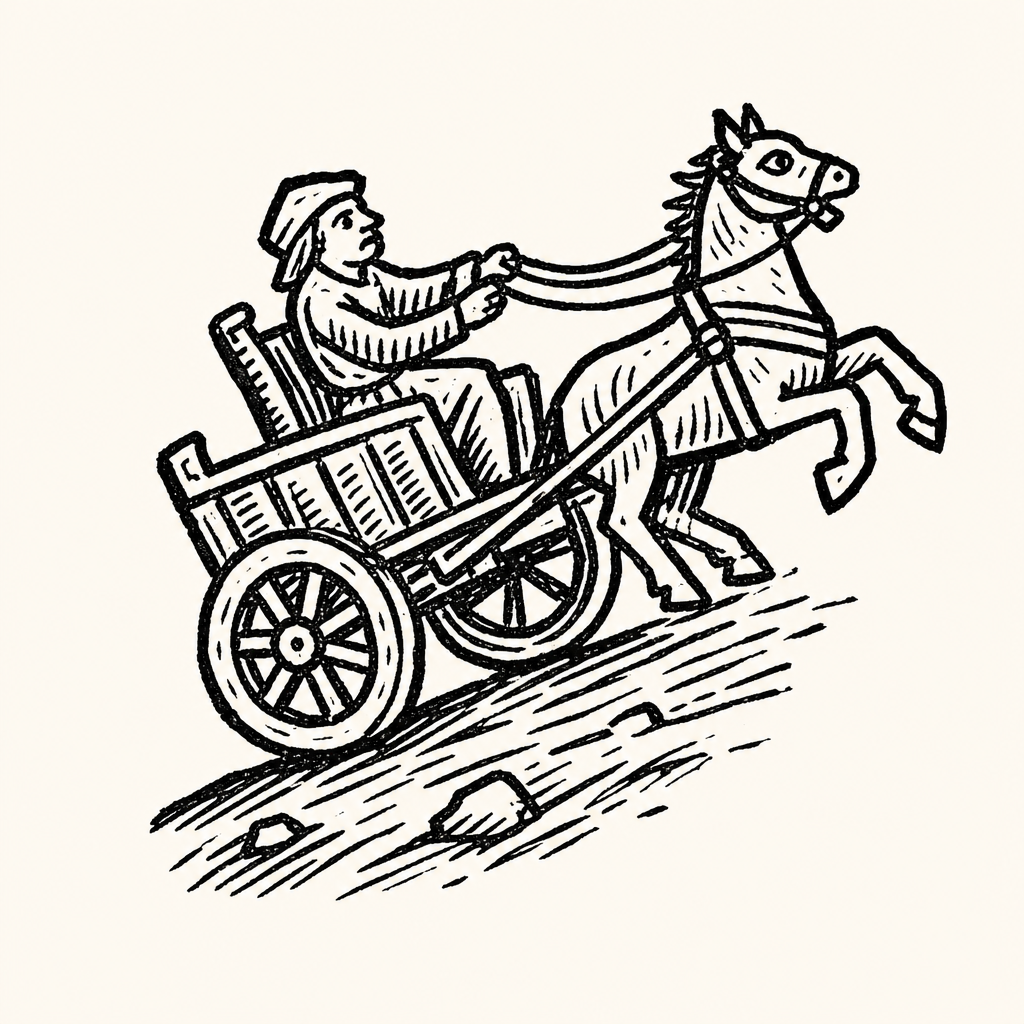
You are driving and you cannot stop, cannot steer, cannot find the brake.
The car has become the modern dream-mind’s most common vehicle for the self-in-motion. Pre-industrial dreamers had horses, ships, carts; in the 20th and 21st centuries the car overwhelmingly carries this symbolic weight in dreams. To dream of driving is to dream of one’s life-direction. To dream of driving and finding the controls have stopped responding is to dream of a familiar modern dread.
The Freudian reading
Freud, before the automobile, classified runaway-vehicle dreams under his broader category of control-loss anxiety. He noted that these dreams cluster around moments when the dreamer has been pretending to be in charge of something that they privately know they are not. The reading is narrower than Jung’s but useful in that exact specific frame.
The Jungian reading
Jung’s broader reading places the car-dream in the architecture of the ego-Self axis: the conscious self is normally “at the wheel” of ordinary life; when the wheel stops responding, the dream is signaling that some part of life has slipped out of ego-control and into unconscious-control. The conscious self has been overestimating its grip. This is uncomfortable but not catastrophic — many of these dreams arrive just before the dreamer asks for help, hands off a project, or admits they cannot keep the pace they have been keeping.
The cognitive-emotional reading
Hartmann’s work on emotional pattern matching (The Nature and Functions of Dreaming, 2011) reads runaway-car dreams as the dream-mind reaching for the most efficient available image of “agency in trouble.” Modern adult dreamers know cars; the dream uses them. The same person, a century ago, would have dreamed of a runaway carriage with the same emotional signature.
Why this dream recurs
Recurrent out-of-control dreams cluster in periods of overwhelm, burnout, addiction-related loss of control, and the months leading up to major changes the dreamer feels they are not driving. The recurrence usually softens once the dreamer has either slowed down or handed off — sometimes literally, sometimes only in the journal.
If the dream changes
- From the driver’s seat to the passenger seat. Often a marker of giving up control consciously rather than having it taken.
- From a crash to a stop. A more graceful surrender.
- From a runaway car to a parked one. The pace has been broken.
When to take it seriously
Recurring out-of-control dreams accompanied by waking-life burnout, panic attacks, addiction-related crises, or actual driving impairment are worth taking seriously and bringing to a therapist or doctor.
If the dream changes…
- Brake failure. Cannot slow down. Often tracks momentum the dreamer has been refusing to interrupt.
- Steering failure. Cannot direct. Loss of waking-life agency or clarity.
- Going too fast. Pace exceeding capacity.
- From the back seat. Someone else is driving your life. Note who.
- Driving over a cliff. Combination — out-of-control plus surrender. Note the landing.
- Crashing without injury. A reassurance form — the loss of control did not actually destroy anything.
What to ask in your journal
If an out-of-control car appears in your dream, sit with these prompts before reaching for an interpretation.
- What was the car doing that you couldn't control — speed, steering, brakes, direction?
- Were you the only one in the car?
- Where in waking life are you behind the wheel of something that has stopped responding to you?
- What was about to happen at the moment you woke?
- Could anyone else have driven? Why aren't you handing it over?


Frequently asked
What does it mean to dream of being unable to control a car?
Almost always a sign that some part of waking life — a project, a relationship, a body, a mood — has stopped responding to the conscious self's inputs. The specific failure (brakes, steering, speed) is the dream's specificity: brake failure tracks inability to slow down; steering failure tracks loss of direction; runaway speed tracks momentum that has gotten ahead of the dreamer.
Does dreaming of a car crash mean I'll be in one?
Almost never literally. Car-crash dreams cluster in periods of *control loss anxiety* and rarely correlate with actual driving incidents. If you are genuinely driving fatigued, distracted, or under stress, however, that is worth taking literally and is a good moment to ask someone else to drive.
Why am I a passenger in my own life-dreams?
Passenger-dreams (you are in the car but not driving) are an interesting variant — the dream is showing that some part of life is moving without your direction. Note who *is* driving; that figure is often the part of you currently in charge.
What does it mean to drive backwards in a dream?
Often a real waking-life regression — toward a previous role, a previous relationship style, a previous coping mode. Sometimes useful; sometimes a signal.
Cited works
Each interpretation on this page traces back to one of these primary sources. Quotation with attribution welcome — see our methodology for how we cite.
- Carl Gustav Jung (1956) *Symbols of Transformation (Collected Works, Vol. 5)*. Princeton University Press. Trans. R. F. C. Hull.
- Sigmund Freud (1899) *The Interpretation of Dreams (Die Traumdeutung)*. Franz Deuticke. Trans. James Strachey (1953). read online
- Ernest Hartmann (2011) *The Nature and Functions of Dreaming*. Oxford University Press.