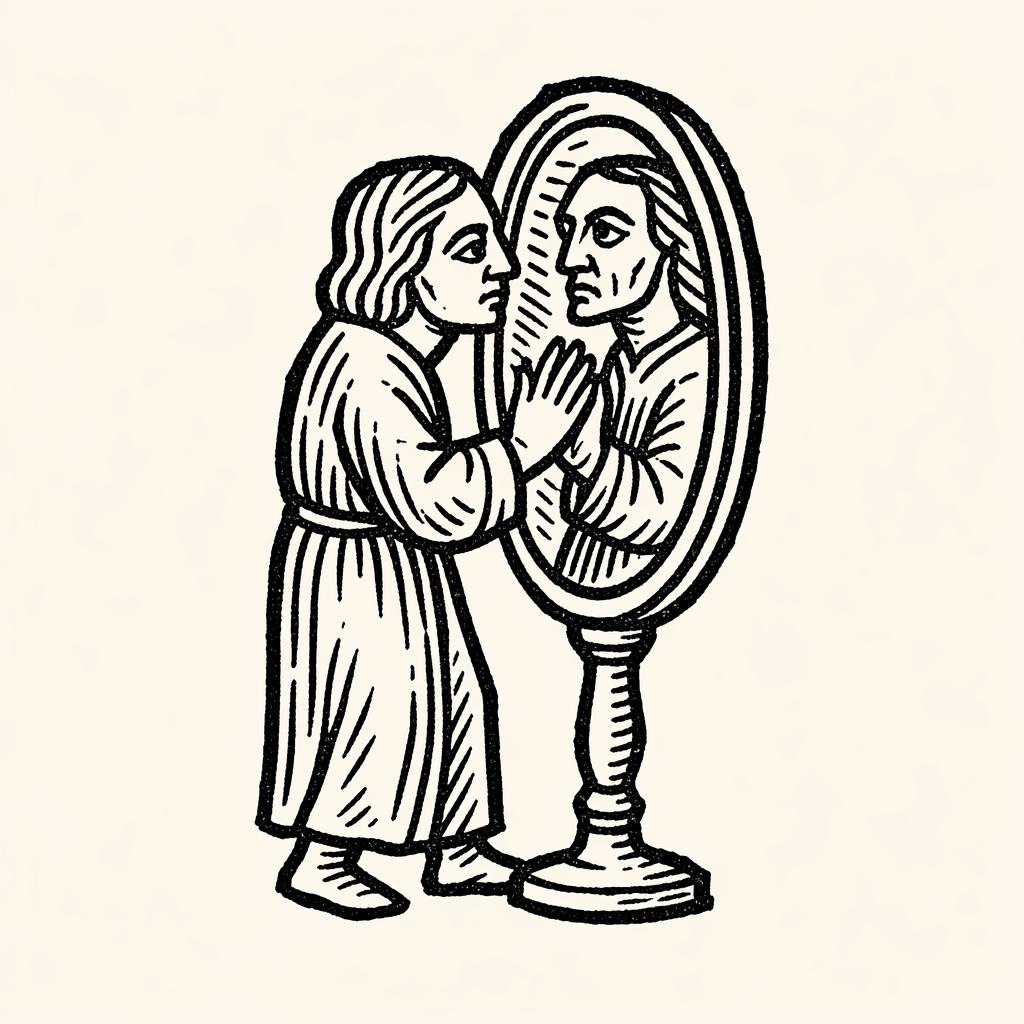
Mirror
The reflective face — self-recognition, distortion, the threshold of the other side.
The mirror is one of the dream-mind’s most concentrated symbols. The reflection is the dream’s image of the dreamer’s relationship to themselves at this moment. Whether the face is your own, slightly altered, frightening, or absent is the dream’s entire verdict.
The Jungian reading
In Jungian terms the mirror sits at the intersection of three major archetypal symbols: the shadow (when the reflection is darker or estranged), the anima/animus (when the reflection is the contrasexual inner figure), and the Self (when the reflection is the dreamer’s true face arriving in unusual clarity). Jung’s case material includes many mirror-dreams as turning-points in analysis.
Greek and folk readings
Greek myth gives us Narcissus — the mirror as fatal misrecognition. The folk traditions of many cultures treat the mirror with caution: covered during mourning, broken at peril, used in scrying. Artemidorus’s Oneirocritica devotes specific attention to mirror-dreams, distinguishing reflections by clarity, posture, and what the reflection does. Ibn Sirin’s Ta’bir al-Ru’ya treats mirror-dreams as dream-portraits of the soul’s current state.
If the dream changes
- From distorted to clear. Self-recognition restored.
- From absent to present. Self has come back into focus.
- From your face to another’s. A new self emerging or an old one being recognized.
- From a single mirror to many. Multiple facets surfacing — common in active analytic work.
Related dreams and symbols
Pair with Shadow, Mask, Doppelgänger, Eye, and the dream of A dead loved one.
What to ask in your journal
If mirror appears in your dream, sit with these prompts before reaching for an interpretation.
- Whose face was in the mirror — yours, slightly altered, or someone else's?
- How did the reflection move? With you, or independently?
- Was the mirror clear, foggy, broken, or empty?
- How did you feel about what you saw?
- What in waking life is asking to be looked at directly?
Frequently asked
What does it mean to dream of looking in a mirror?
Mirror-dreams are dreams of self-recognition. The face shown is the dream's verdict on the state of the dreamer's current relationship to themselves: clear if integration is good, distorted if not, absent if the dreamer has lost touch with some essential part of self.
What does it mean to see a different face in a mirror?
Often the dream's image of an unrecognized part of self — sometimes shadow, sometimes a younger or older version, sometimes an emerging self the conscious mind has not yet met.
What does it mean to dream of a broken mirror?
Folk traditions read it as misfortune; depth-psychology reads it as fragmentation of self-image, often the start of a necessary breakup of an old identity. Both can be true at once.
What does it mean if the mirror shows nothing?
An absent reflection is one of the most striking forms — usually a sign that some central self-recognition has gone temporarily missing. Worth taking seriously.
Cited works
Each interpretation on this page traces back to one of these primary sources. Quotation with attribution welcome — see our methodology for how we cite.
- Carl Gustav Jung (1959) *The Archetypes and the Collective Unconscious (Collected Works, Vol. 9, Part 1)*. Princeton University Press. Trans. R. F. C. Hull.
- Carl Gustav Jung (1956) *Symbols of Transformation (Collected Works, Vol. 5)*. Princeton University Press. Trans. R. F. C. Hull.
- Artemidorus of Daldis (c. 2nd century CE) *Oneirocritica (The Interpretation of Dreams)*. Oxford University Press. Trans. Daniel E. Harris-McCoy (2012).
- Muhammad Ibn Sirin (c. 8th century CE) *Ta'bir al-Ru'ya (Interpretation of Dreams)*Foundational text of Islamic oneirocriticism; later compiled and commented by ibn Shahin and ibn al-Naqib.