Teeth Falling Out
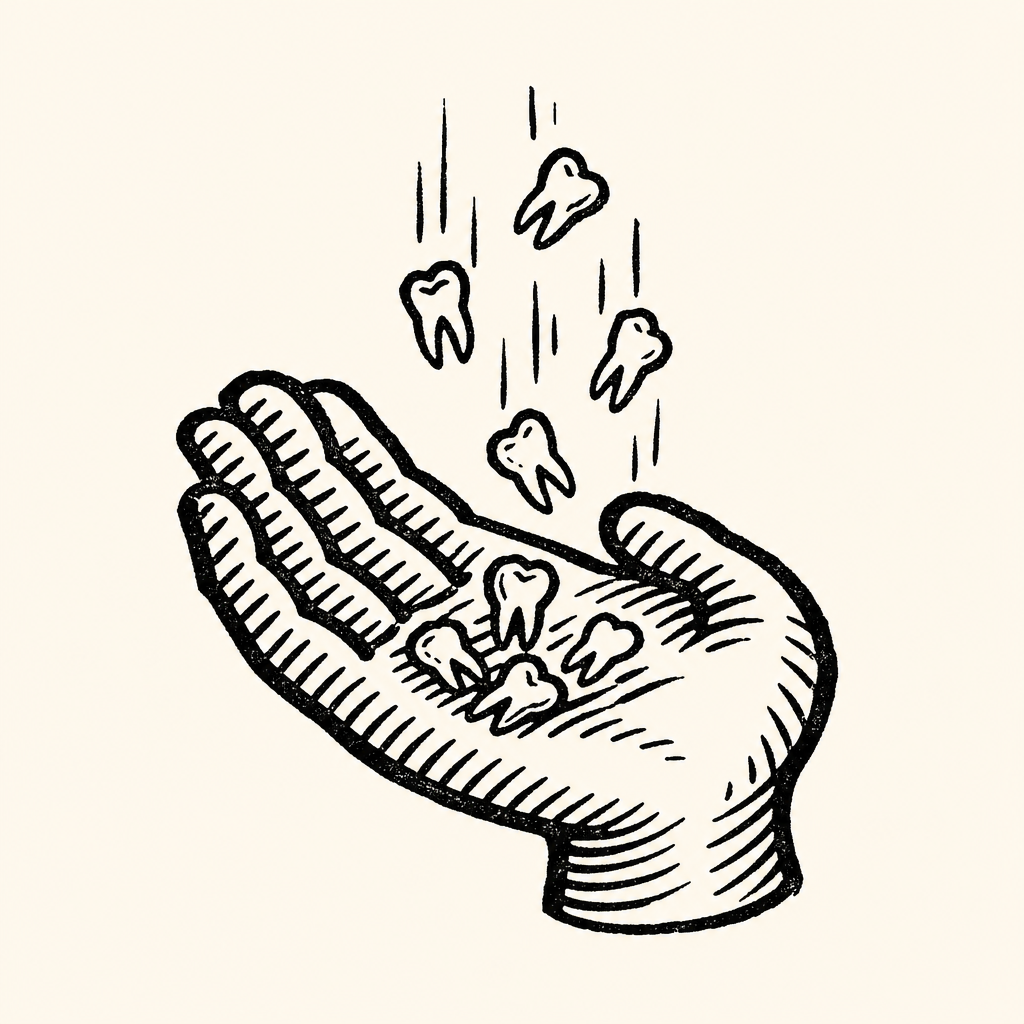
Anxiety about appearance, power, or something you cannot 'hold onto.'
The teeth-falling-out dream is one of the most-reported and most-asked-about dreams on record. Artemidorus describes it in Oneirocritica in the 2nd century CE. Freud devotes pages to it in Die Traumdeutung in 1899. Hall and Van de Castle’s mid-century norms find it among the top-twenty most common dream contents in adult Americans. Modern Chinese, Korean, and Iranian dream-traditions all have specific readings of it. The universality is striking; so is the universality of the underlying theme that almost every tradition agrees on.
That theme is anxiety about something the dreamer fears they are losing the ability to hold.
The Freudian reading
Freud, in Die Traumdeutung (1899, ch. 5–6), classifies teeth-loss dreams in adult men as displaced castration imagery — anxiety about virility, authority, or sexual function projected upward to a less-threatening body part. In adult women, he reads similar dreams as fears around childbirth, loss of parental authority, or the aging process. The reading is narrower than later traditions and is most useful when the dream arrives in an explicitly sexual or generational context.
The Jungian reading
Jung treats teeth as symbols of aggression, vitality, and the capacity to “bite” the world (CW 5, Symbols of Transformation). To lose them is to fear the loss of one’s edge — one’s ability to push back, to defend, to make a clean cut. He reads recurrent teeth-loss dreams in midlife patients as tracking the moment when an old style of force in the world no longer fits and a new register of power is being asked for. The dream is often the soft announcement of that change.
Greek antiquity
Artemidorus, in Oneirocritica (2nd c. CE), gives teeth-dreams a remarkably detailed treatment. He reads upper teeth as representing “those above us” (parents, masters, elders) and lower teeth as representing “those below us” (children, dependents, juniors). The loss of an upper tooth is, in his classification, the loss or weakening of a relationship with someone above; the loss of a lower tooth, with someone below. The reading is folk-symbolic rather than depth-psychological, but its specificity is striking, and many dreamers find that mapping useful.
Chinese folk tradition
In several Chinese dream-traditions (recorded in the Zhou Gong Jie Meng and successor compilations), teeth-loss dreams are sometimes read as portents of illness in elder family members — qin ren you huo — a reading worth knowing if it is your tradition. We do not endorse it literally but we record it accurately. Korean folk readings carry similar threads.
Why this dream recurs
Teeth-loss dreams cluster, in modern dream-content research (Domhoff, Bulkeley), in three life-periods:
- Adolescence — when the social-image self is being formed under acute peer scrutiny.
- Early career and parenthood — when authority and capacity feel under constant test.
- Midlife — when the old way of being effective in the world is no longer quite working.
The recurrence softens once the underlying tension is named — even before it is resolved.
If the dream changes
- From sudden loss to gradual loss. The conscious self has begun to see the slow thing it was missing.
- From spitting teeth to replacing teeth. The reconstructive phase.
- From teeth-loss to mouth-blocked dreams. The dream is shifting to the voice-and-silencing register; ask what you are not saying.
When to take it seriously
Persistent teeth-loss dreams accompanied by real bruxism, jaw pain, or ongoing waking anxiety should be brought to both a dentist and a therapist. The dream-body and the waking-body are usually working on the same problem.
If the dream changes…
- Teeth falling out one by one. Often a slow, ongoing erosion in waking life — an aging, a long-running relationship under strain, a status quietly diminishing.
- Spitting out a mouthful of teeth. The dream's shock-form. Usually marks a sudden recognition that something held back has finally given way.
- Teeth crumbling in the mouth. Helplessness under a slow process. Pay attention to what waking-life slow-thing it tracks.
- Pulling out your own teeth. Active surrender. Sometimes a marker of relief.
- Teeth falling while you speak. Voice and authority under threat. Most common during professional struggles.
- Replacing fallen teeth. The integration phase — the conscious self answering the loss with reconstruction.
What to ask in your journal
If teeth falling out appears in your dream, sit with these prompts before reaching for an interpretation.
- What in your appearance, voice, or self-presentation feels under threat right now?
- Where in waking life are you trying to 'hold on' to something that may no longer be yours to hold?
- Have you been silenced — at work, in relationship, in a family system — in a way you have been refusing to admit?
- Did you watch the teeth fall, lose them while speaking, or only realize after?
- What did you do with the fallen teeth — keep them, hide them, lose them, replace them?

Frequently asked
What does it mean to dream of your teeth falling out?
Across nearly every dream-tradition, teeth-loss dreams are read as anxiety about *something the dreamer fears they are losing the ability to hold onto* — appearance, power, voice, control, status, attractiveness. Modern research (Hall, Domhoff, Bulkeley) finds these dreams clustered in periods of self-image stress, social comparison, and major life transitions.
Is dreaming of teeth falling out a bad omen?
In Chinese folk tradition, the dream is sometimes read as a portent of illness in an elder family member — a reading worth knowing if it is your tradition. In depth-psychological terms, the dream is overwhelmingly about the dreamer's own self-image and rarely points to literal events outside the self.
Why do I keep dreaming about my teeth?
Recurrent teeth-dreams almost always track an unresolved tension around voice, appearance, or a status-anxiety the conscious self has been minimizing. The recurrence softens as the underlying tension is named, even before it is resolved.
What does Freud say about teeth-falling-out dreams?
Freud, in *Die Traumdeutung* (1899), reads teeth-loss dreams in adult men as displaced castration imagery and in women as displaced fears around childbirth or losing parental authority. The reading is narrower than later traditions but worth knowing — particularly when the dream arrives in an explicitly sexual or generational context.
What does it mean to dream of teeth crumbling?
A particular variant — the gradual, helpless disintegration. Almost always tied to a slow waking-life process the dreamer has been unable to stop: an aging, a relationship eroding, a position weakening. Look for the slow thing rather than the sudden one.
Cited works
Each interpretation on this page traces back to one of these primary sources. Quotation with attribution welcome — see our methodology for how we cite.
- Carl Gustav Jung (1956) *Symbols of Transformation (Collected Works, Vol. 5)*. Princeton University Press. Trans. R. F. C. Hull.
- Sigmund Freud (1899) *The Interpretation of Dreams (Die Traumdeutung)*. Franz Deuticke. Trans. James Strachey (1953). read online
- Artemidorus of Daldis (c. 2nd century CE) *Oneirocritica (The Interpretation of Dreams)*. Oxford University Press. Trans. Daniel E. Harris-McCoy (2012).
- Kelly Bulkeley (2016) *Big Dreams: The Science of Dreaming and the Origins of Religion*. Oxford University Press.