Finding Money
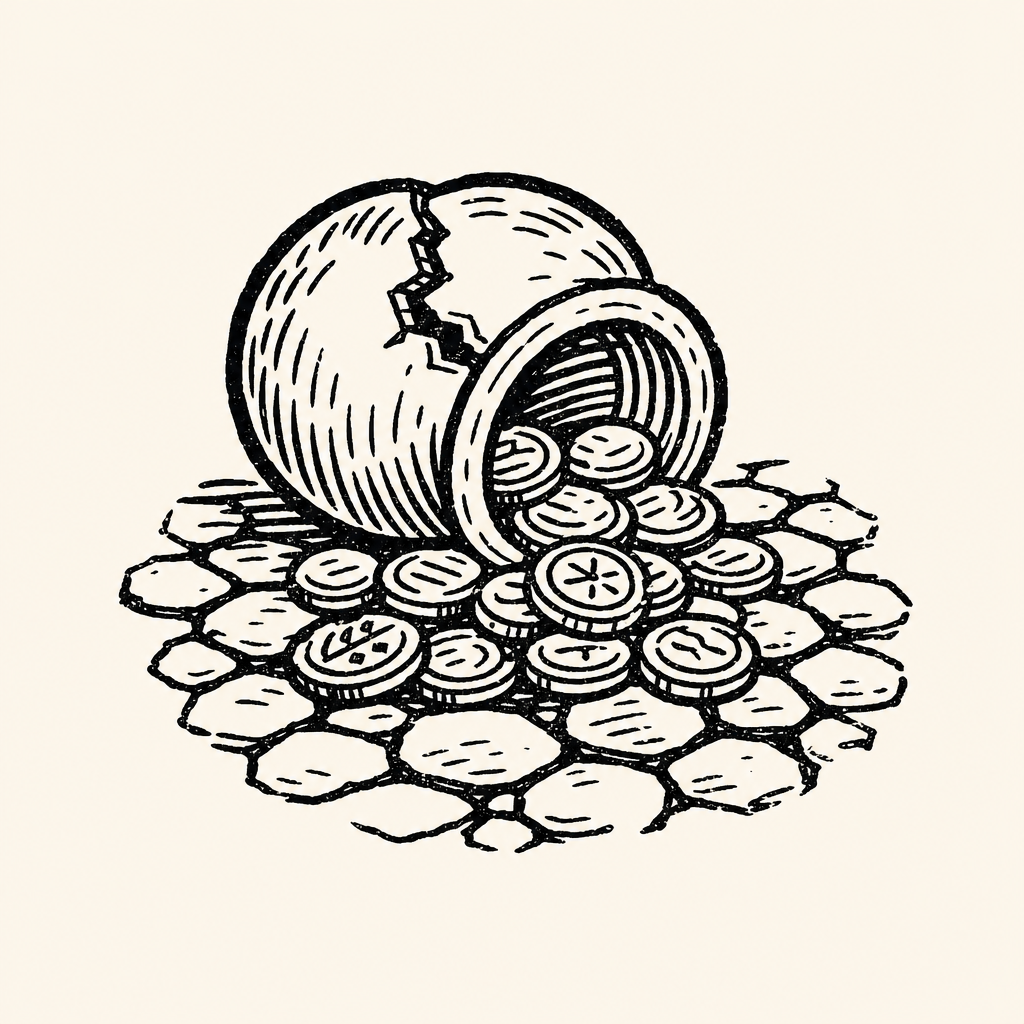
Coins, bills, treasure — discovered, sometimes hoarded, sometimes lost again.
The finding-money dream is one of the most consistently benevolent of the common dreams in modern surveys — most dreamers wake from it with a warm or curious feeling, even when the amount of money was small. Across nearly every dream tradition the symbol is read favorably: as discovered value, as recognition, as the alchemical gold the dreamer has been pursuing without knowing.
The Jungian reading
Jung’s lifelong interest in alchemy gives his reading particular weight here. In Psychology and Alchemy (CW 12), the alchemical aurum non vulgi — “gold not of the common kind” — is the central symbol of the Self: the value that cannot be manufactured, only discovered, often in the most ordinary places. Finding-money dreams in Jungian case material cluster around moments when the dreamer is on the cusp of recognizing something true about themselves: a capacity, a value, a vocation. The amount is rarely the point.
The Freudian reading
Freud’s reading is, characteristically, more circumspect. He notes (Die Traumdeutung, ch. 6) that money in dreams sometimes carries displaced content — sexual, anal, possessive — and that the finding version is more often a wish-fulfillment of basic security than a deep symbol. The reading is useful when the dream arrives in the context of acute financial distress, where it may simply be the dreamer’s wish for the problem to be solved.
Folk and Sufi readings
Folk traditions in many cultures treat finding-money dreams as auspicious. Ibn Sirin’s Ta’bir al-Ru’ya devotes specific attention to dreams of dirham and dinar, classifying them by amount and material: gold-dreams favorable, copper-dreams less so, dreams of damaged or counterfeit coins as warnings about misplaced trust.
Why this dream recurs
Recurrent finding-money dreams cluster in periods of personal recognition, the early stages of creative breakthrough, and during recovery — when the conscious self is starting to register value that had been hidden. The recurrence usually fades once the value has been named.
If the dream changes
- From small amounts to large. The recognition is becoming more conscious.
- From finding to keeping to spending. Integration progressing.
- From real money to symbolic gold. The dream is dropping its modern disguise; the symbol is showing itself plainly.
- From finding to giving. Real maturation; the discovered value is being put back into the world.
When to take it seriously
Money-finding dreams rarely need professional handling. The exception is during real acute financial distress, where the dream may be tracking displaced anxiety. In that case, address the financial reality alongside engaging the dream.
If the dream changes…
- Finding a small coin. A modest, reliable recognition of value.
- Finding hidden treasure. Big-feeling dream of breakthrough; track what changes after.
- Finding money and losing it. Touched something not yet integrated.
- Finding old coins. Ancestral or buried value.
- Finding money that turns to nothing. Often inflation followed by deflation; pay attention to where the conscious self overestimated.
What to ask in your journal
If finding money appears in your dream, sit with these prompts before reaching for an interpretation.
- Where did you find the money — a pocket, a drawer, the ground, a hidden compartment?
- How much was it? How did you feel about the amount?
- Did you keep it, lose it, share it, hide it?
- What in waking life carries value you have been overlooking?
- Is there an actual financial concern the dream is also gently addressing?

Frequently asked
What does it mean to dream of finding money?
Across nearly every dream-tradition, finding-money dreams are read as the discovery of value the conscious self has been overlooking — sometimes literal, often metaphoric. The Jungian reading places the discovered coin in the long alchemical lineage of *aurum non vulgi* (gold not of the common kind): the value that is found, not earned.
Is finding money in a dream lucky?
Folk traditions in many cultures (Chinese, English, Italian, Korean) treat the dream as auspicious. Modern dream content research finds these dreams cluster in periods of personal recognition, integration, and creative breakthrough — which makes the folk reading more right than wrong, even if not literally.
What does it mean to lose found money in a dream?
The discovered value not yet integrated. The dreamer has touched something but has not yet been able to take it home.
What does it mean to find a small amount?
Often a more reliable form than finding a fortune — small, real recognitions of value tend to track real waking-life integrations more cleanly than the dramatic windfall.
What does it mean to find an old coin or treasure?
Across multiple traditions, the *old* coin is the dream's image of an ancestral or long-buried value. Often appears during family-of-origin work, recovery, or genealogical curiosity.
Cited works
Each interpretation on this page traces back to one of these primary sources. Quotation with attribution welcome — see our methodology for how we cite.
- Carl Gustav Jung (1953) *Psychology and Alchemy (Collected Works, Vol. 12)*. Princeton University Press. Trans. R. F. C. Hull.
- Sigmund Freud (1899) *The Interpretation of Dreams (Die Traumdeutung)*. Franz Deuticke. Trans. James Strachey (1953). read online
- Muhammad Ibn Sirin (c. 8th century CE) *Ta'bir al-Ru'ya (Interpretation of Dreams)*Foundational text of Islamic oneirocriticism; later compiled and commented by ibn Shahin and ibn al-Naqib.
- Artemidorus of Daldis (c. 2nd century CE) *Oneirocritica (The Interpretation of Dreams)*. Oxford University Press. Trans. Daniel E. Harris-McCoy (2012).