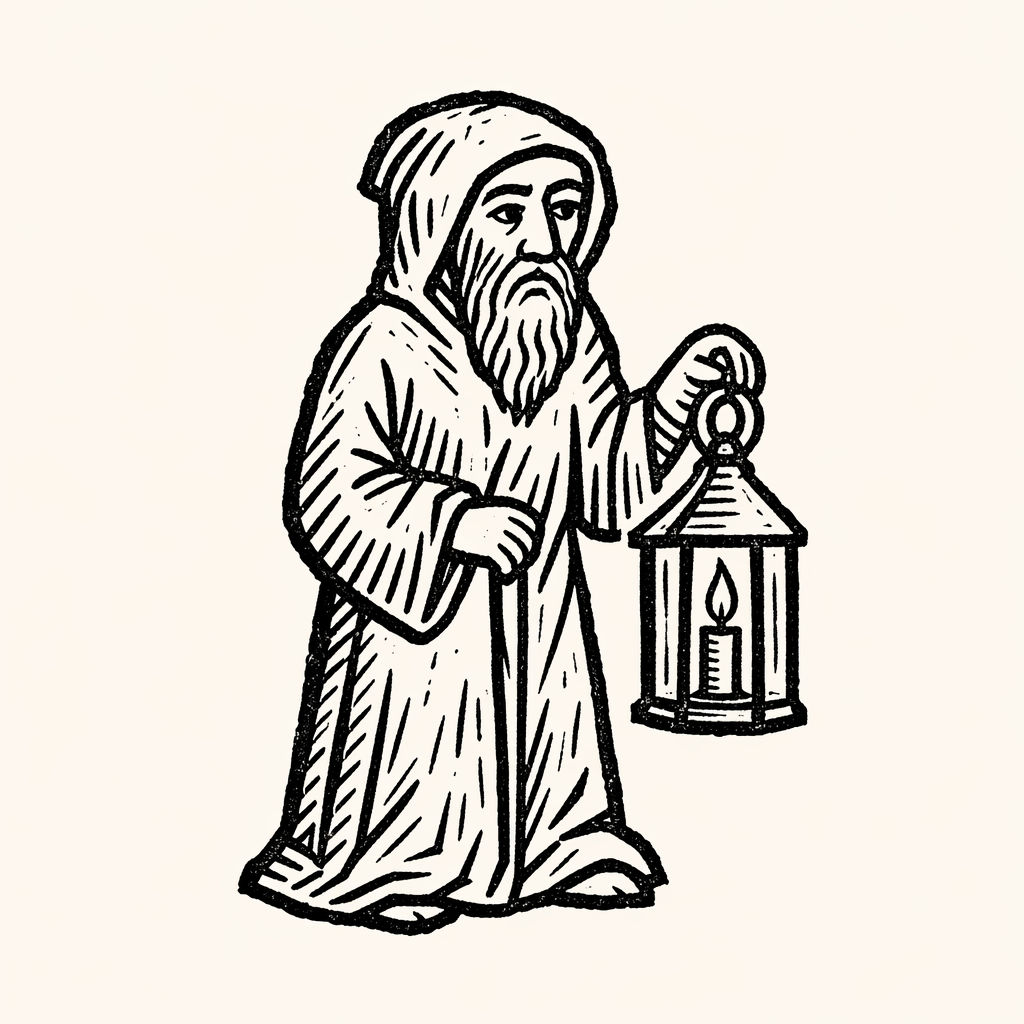
Wise Old Man
Jung's archetype of accumulated wisdom — the inner teacher, the senex.
The Wise Old Man is Jung’s archetype of accumulated wisdom — the inner teacher who arrives at moments of necessary insight. He appears across nearly every dream-tradition: Khidr in Sufi tales, Elijah in the Hebrew and Christian register, Merlin in the Arthurian, the hermit in the European folk imagination. The figure is not always benign; the dream’s emotional tone is what distinguishes the genuine teacher from the negative senex — the rigid, bitter old man whose wisdom has gone sour.
The Jungian reading
Jung treats the Wise Old Man at length in The Archetypes and the Collective Unconscious (CW 9i), placing him among the central archetypes of individuation. Recurrent Wise Old Man dreams cluster in mid-life and beyond, often during periods when the dreamer is being asked to assume a new authority of their own.
Cross-cultural readings
In Sufi tradition, Khidr is the immortal teacher of Sura 18 (the Cave) who arrives unexpectedly to teach by paradoxical action. In the Hebrew and Christian register, Elijah occupies a parallel position — the prophet who returns. In multiple Indigenous traditions of the Americas, the elder is a dream-figure of cultural weight; we mention this carefully and only as the traditions hold it.
If the dream changes
- From cryptic to clear. The teaching has begun to land.
- From received-with-resistance to received-with-gratitude. The dreamer has stopped fighting the help.
- From an external teacher to an inner voice. Internalization underway.
- From benign to bitter. Worth attending to — the negative senex is the same archetype gone wrong.
Related dreams and symbols
What to ask in your journal
If wise old man appears in your dream, sit with these prompts before reaching for an interpretation.
- What did the old man look like? Was he kindly, severe, cryptic, mute?
- What did he say or give you?
- Did you receive him willingly, or with resistance?
- What in waking life is asking for your own elder wisdom?
- Is there a teacher you have been refusing because of pride or fear?
Frequently asked
What does the Wise Old Man mean in Jungian dream interpretation?
The Wise Old Man is the archetype of accumulated wisdom — the inner teacher who arrives at moments of necessary insight. Jung treated him as one of the central archetypes of individuation, particularly in mid-life and beyond.
Is the Wise Old Man always benign?
No. The *negative senex* — the bitter, rigid, spiteful old man — is also a dream-figure and is the wisdom-archetype gone rancid. The dream's emotional tone is the diagnostic.
Who is Khidr?
Khidr (al-Khaḍir) is the immortal teacher-figure in Sufi tradition, drawn from the Qur'anic narrative of Sura 18. He arrives unexpectedly to those in need of guidance and teaches by paradoxical action.
Can the Wise Old Man appear as a woman?
The wisdom-archetype's feminine form is the Wise Old Woman, sometimes the Crone — Sophia, Hecate, the grandmother. Both are valid dream-forms; the gender of the dreamer is not determinative.
Cited works
Each interpretation on this page traces back to one of these primary sources. Quotation with attribution welcome — see our methodology for how we cite.
- Carl Gustav Jung (1959) *The Archetypes and the Collective Unconscious (Collected Works, Vol. 9, Part 1)*. Princeton University Press. Trans. R. F. C. Hull.
- Carl Gustav Jung (1956) *Symbols of Transformation (Collected Works, Vol. 5)*. Princeton University Press. Trans. R. F. C. Hull.
- Carl Gustav Jung (1962) *Memories, Dreams, Reflections*. Pantheon Books.
- Anonymous (attributed to Matthew) (c. 80–90 CE) *New Testament — Gospel of Matthew (chapters 1, 2, 27)*
- Barbara Tedlock (ed.) (1987) *Dreaming: Anthropological and Psychological Interpretations*. Cambridge University Press.