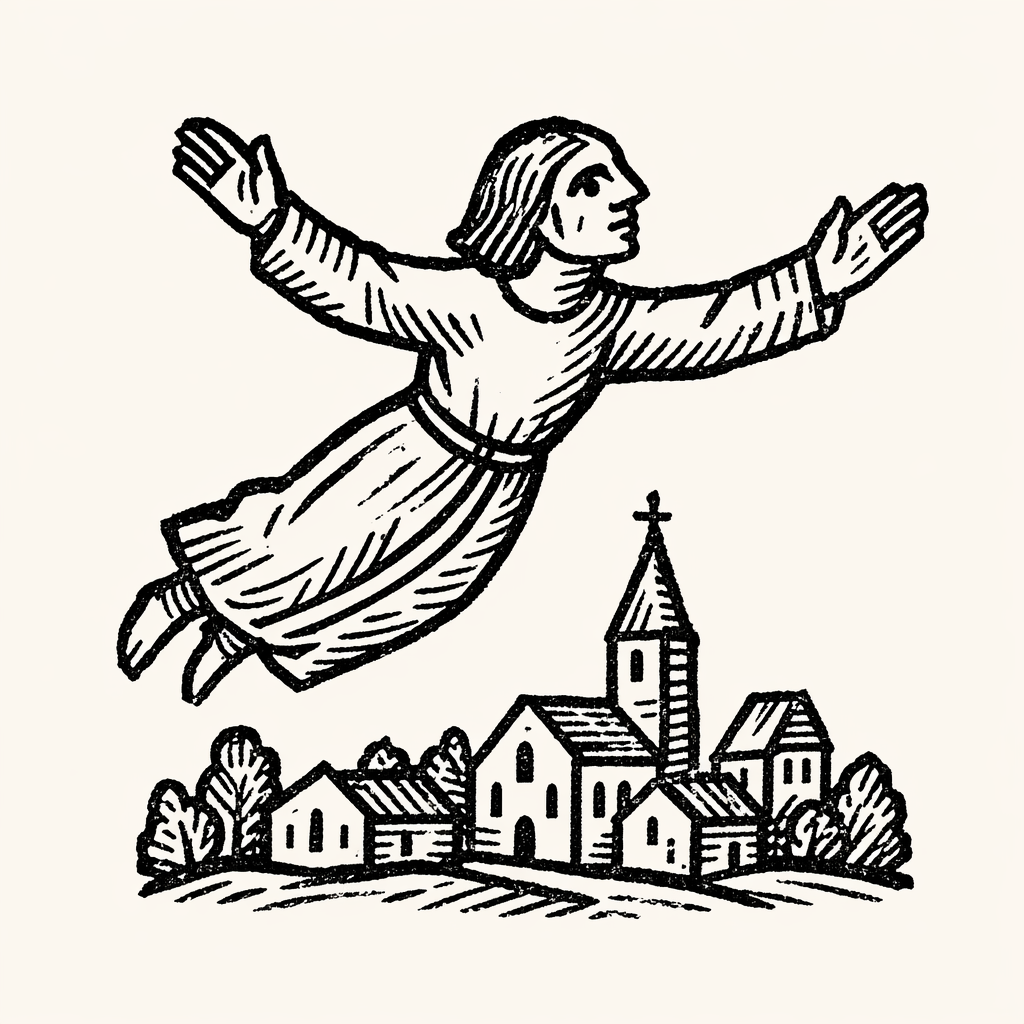
Flying
Transcendence, lucidity, growth — the rising self.
Flying is one of the most pleasurable dreams a human being can have, and one of the most consistently positive in its symbolic register. The Upanishads speak of the dream-self moving freely above the body. Plato has Socrates speak of philosophy itself as the “feathering of the soul.” Sufi mystical poetry is shot through with images of the soul-bird taking flight. Modern empirical studies of dream content find flying-dreams disproportionately common in two groups: lucid dreamers, and people actively working on psychological growth.
See also the dream-entry Flying for the long-form treatment.
The Jungian reading
For Jung, flying-dreams are images of transcendence — moments when the psyche briefly rises above the conditions that ordinarily constrain it (CW 9i). He notes their frequency in people who have just made a difficult and right decision. The exception, which he flags carefully: flying as escape — flight from something on the ground that the conscious self is refusing to face.
Hindu, Sufi, Greek readings
In Hindu yogic literature, the dream-state is one of the places where the sukshma sharira (the subtle body) becomes briefly mobile; flying-dreams are read as the subtle body lifting. In Sufi tradition, Ibn Sirin’s Ta’bir al-Ru’ya classifies flying as auspicious provided the dreamer remains in their human form. Artemidorus’s Oneirocritica treats flying as nearly always favorable, distinguishing flight on one’s own (a debt-free rising) from flight on the back of something (a debt being incurred).
If the dream changes
- From effortful to effortless. Integration progressing.
- From low to high. Range increasing — sometimes a real maturation, sometimes inflation.
- From flight-as-escape to flight-with-purpose. A real shift.
Related dreams and symbols
What to ask in your journal
If flying appears in your dream, sit with these prompts before reaching for an interpretation.
- Were you flying with effort or without?
- What were you flying away from — or toward?
- How high were you?
- Was the flight pleasurable, frightening, both?
- Did anyone watch you fly?

Frequently asked
What does it mean to dream of flying?
Flying-dreams almost always carry positive valence and cluster in periods of psychological growth, creative breakthrough, or major decisions made well.
Why are flying dreams so vivid?
Flying-dreams correlate strongly with *lucid dreaming* — the awareness, while dreaming, that one is dreaming.
What does it mean to fly with effort?
The conscious self is reaching for an elevation it has not yet fully earned. A marker of an early-phase transformation.
Are flying dreams good?
Almost always. The exceptions are flying-as-escape and flying-with-fear-of-falling, both of which are still informative.
Cited works
Each interpretation on this page traces back to one of these primary sources. Quotation with attribution welcome — see our methodology for how we cite.
- Carl Gustav Jung (1959) *The Archetypes and the Collective Unconscious (Collected Works, Vol. 9, Part 1)*. Princeton University Press. Trans. R. F. C. Hull.
- Carl Gustav Jung (1956) *Symbols of Transformation (Collected Works, Vol. 5)*. Princeton University Press. Trans. R. F. C. Hull.
- Vedic seers (anonymous) (c. 700 BCE) *Brihadaranyaka Upanishad (4.3, on the dream-state)*
- Muhammad Ibn Sirin (c. 8th century CE) *Ta'bir al-Ru'ya (Interpretation of Dreams)*Foundational text of Islamic oneirocriticism; later compiled and commented by ibn Shahin and ibn al-Naqib.
- Artemidorus of Daldis (c. 2nd century CE) *Oneirocritica (The Interpretation of Dreams)*. Oxford University Press. Trans. Daniel E. Harris-McCoy (2012).