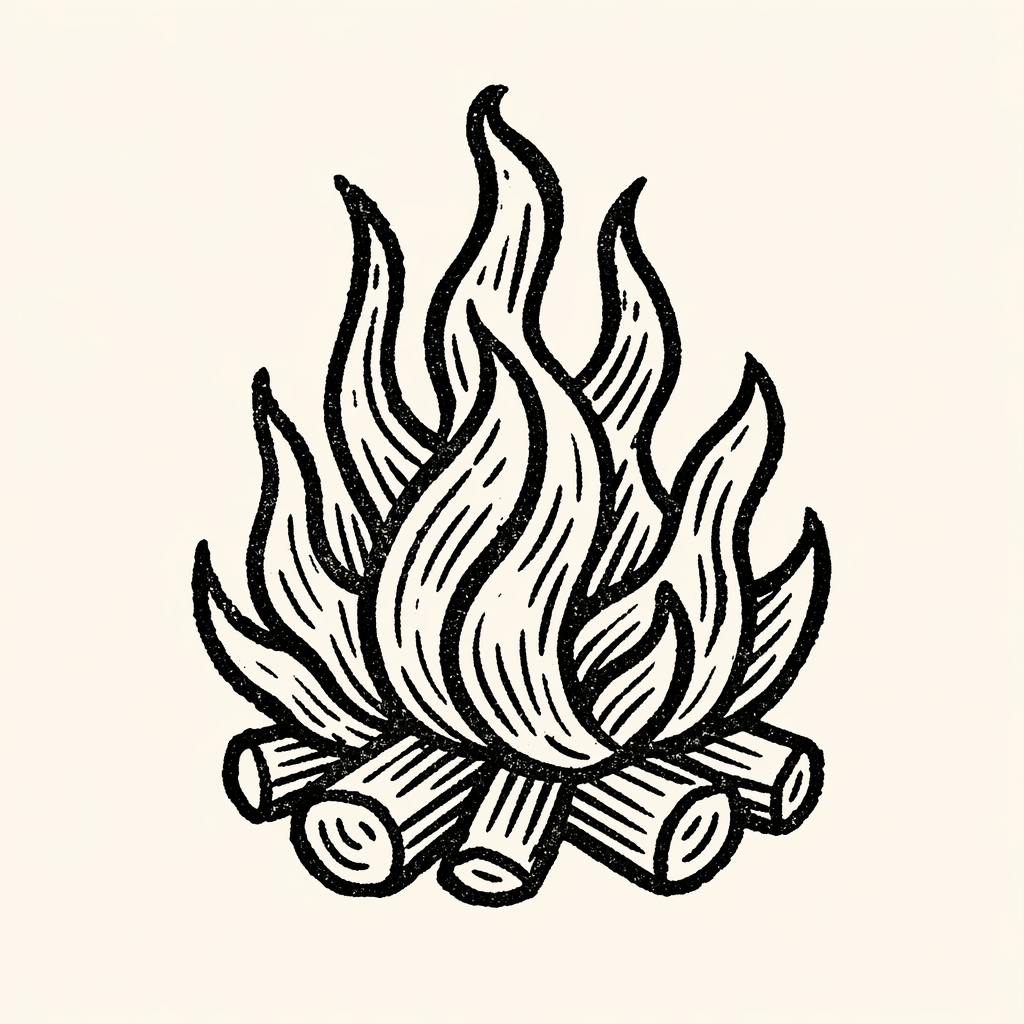
Fire
Transformation as agent — destruction, illumination, eros, purification.
Fire is the only element that changes everything it touches. It cooks food, smelts metal, lights the room, and ends the building. Unsurprisingly, it is one of the most polyvalent dream-symbols on record. The Atharvaveda addresses Agni — fire personified — as both household god and inner sacrifice. Heraclitus called the cosmos “an ever-living fire.” The Christian Pentecost (Acts 2) is fire descending in the form of tongues. Sufi mystical poetry from Rumi to Hafiz to Ibn al-Farid is fire shot through.
When fire appears in your dream, ask first what the fire is doing.
The Jungian reading
Jung treated fire as the energetic substrate of the unconscious in its transformative aspect (CW 5; CW 12 on alchemy). Where water-symbols image the unconscious as medium, fire-symbols image it as agent. In Symbols of Transformation he gathers fire-dreams clustering around major life changes: house-fires before divorces, wildfires before resignations, candles being lit at the start of analytic work. The friendliness or violence of the dream-fire tracks the conscious self’s relation to the change.
Vedic, Greek, Christian, Sufi readings
Agni is the central god of the Atharvaveda — household hearth, cremation flame, the inner jathar-agni (digestive fire). The Greek inheritance is double: Hephaestus’s productive forge-fire and Prometheus’s transgressive stolen fire. The Christian Pentecost makes fire the literal form of the descending Spirit. Sufi mystical poetry treats fire overwhelmingly as the symbol of erotic-mystical longing — the moth into the candle.
If the dream changes
- From wildfire to hearth. The transformation has been brought into containment.
- From burning house to ash. The change has completed; the next dream-cycle is the rebuild.
- From feared fire to walked-into fire. The dreamer has accepted the initiation.
Related dreams and symbols
What to ask in your journal
If fire appears in your dream, sit with these prompts before reaching for an interpretation.
- Was the fire warming, illuminating, or consuming?
- Did you light it, watch it, fight it, walk into it?
- What was the fire eating — a known building, a familiar object, an unknown landscape?
- Did the fire feel sacred or catastrophic?
- Where in waking life is something old refusing to die that the dream may be offering to consume?

Frequently asked
What does it mean to dream of fire?
Fire is one of the oldest cross-cultural dream-symbols of transformation. Friendly fire (warmth, light, hearth) reads as integrated transformation; consuming fire (the burning house, the wildfire) reads as transformation that has slipped beyond conscious control.
Is dreaming of a house on fire bad?
Rarely literal. House-fire dreams classically represent the consuming end of a phase of life — a marriage, a job, a self-image, a family system.
What does it mean to dream of being burned?
To dream of being burned without dying is, in many depth-psychological readings, an image of *initiation* — the old self consumed, the new one not yet formed. Sufi and alchemical traditions both call this the *furnace* of transformation.
What does it mean to put out a fire in a dream?
Often the dreamer's conscious effort to contain or refuse a transformation that is underway. Whether the dream lets you succeed, fail, or wakes you mid-effort is itself the answer.
Cited works
Each interpretation on this page traces back to one of these primary sources. Quotation with attribution welcome — see our methodology for how we cite.
- Carl Gustav Jung (1956) *Symbols of Transformation (Collected Works, Vol. 5)*. Princeton University Press. Trans. R. F. C. Hull.
- Carl Gustav Jung (1953) *Psychology and Alchemy (Collected Works, Vol. 12)*. Princeton University Press. Trans. R. F. C. Hull.
- Vedic seers (anonymous) (c. 1200–1000 BCE) *Atharvaveda*Books 6, 7, and 16 contain dream classifications and apotropaic formulas; the swapna-sukta tradition develops here.
- Anonymous (attributed to Matthew) (c. 80–90 CE) *New Testament — Gospel of Matthew (chapters 1, 2, 27)*
- Muhammad Ibn Sirin (c. 8th century CE) *Ta'bir al-Ru'ya (Interpretation of Dreams)*Foundational text of Islamic oneirocriticism; later compiled and commented by ibn Shahin and ibn al-Naqib.