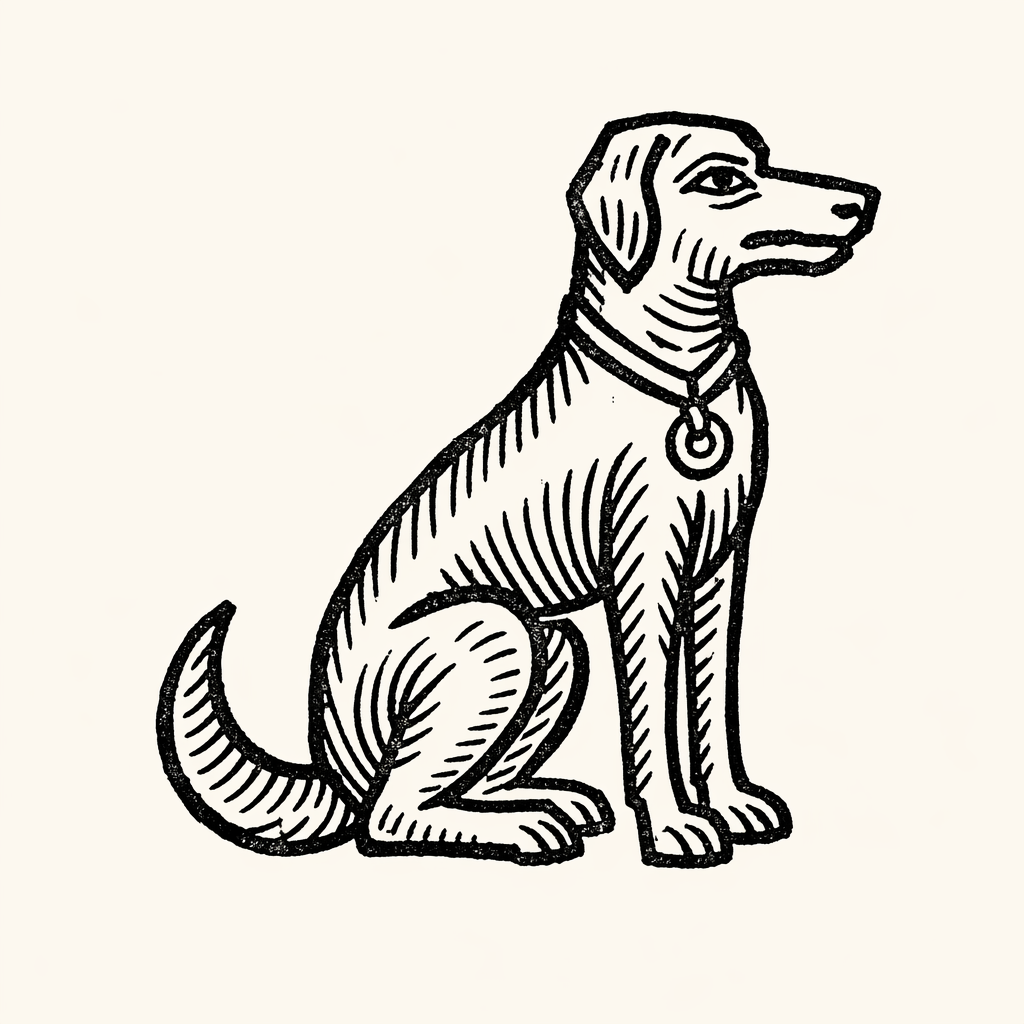
Dog
Loyalty, instinct, the threshold guardian — Anubis, Cerberus, the family dog.
The dog is one of the most universally companionable dream-symbols on record — and one of the most ambivalent. Across nearly every dream- tradition with a literature, the dog stands at thresholds: Anubis guiding souls between worlds in the Egyptian register, Cerberus guarding the gate of the underworld in the Greek, the family dog at the door of the dreamer’s own house. The same animal that is most familiar to humans is the one that has most consistently been imagined as the guardian of the boundary between worlds.
The Jungian reading
Jung treats the dog primarily as a symbol of the dreamer’s instinctual life. A friendly, faithful dog is instinct integrated; a neglected or hungry dog is instinct that has been refused care; an attacking dog is instinct that has been refused and is asserting itself. Recurrent dog-dreams often track real shifts in the dreamer’s relationship to their own instinctual life.
Cross-cultural readings
Anubis (Egyptian) is the canine-headed guide of souls between worlds. Cerberus (Greek) is the three-headed dog at the gate of Hades. Ibn Sirin’s Ta’bir al-Ru’ya classifies dog-dreams by behavior, treating faithful dogs as auspicious and biting dogs as warnings about a known person’s hostility. Artemidorus’s Oneirocritica attends similarly.
In multiple Indigenous traditions of the Americas, dogs and wolves carry particular dream-weight; we mention this with care.
If the dream changes
- From threatening to friendly. Instinct re-honored.
- From neglected to fed. Real attention to the instinctual life.
- From a single dog to a pack. A larger instinctual ground emerging.
- From an unknown dog to your own. The instinctual material has become personally located.
Related dreams and symbols
What to ask in your journal
If dog appears in your dream, sit with these prompts before reaching for an interpretation.
- Was the dog familiar or unknown? Yours, or another's?
- Was the dog protective, threatening, playful, neglected?
- What breed or size was it?
- What in waking life is asking for instinctual loyalty rather than analysis?
- What threshold is the dream's dog guarding?
Frequently asked
What does it mean to dream of a dog?
Dogs in dreams classically represent *loyalty, instinct,* and the *threshold guardian*. The specific dog matters: a familiar dog reads as the dreamer's own instinctual life; an unknown dog as instinct in a less personalized register; a threatening dog as instinct that has been mistreated or neglected.
What does it mean to dream of a dog attacking?
Often the dream's image of the dreamer's own instincts attacking back after long neglect. Frequently softens once the underlying instinctual life has been honored.
What does Anubis or Cerberus mean in a dream?
When the dog appears in mythological form, the dream is working at archetypal scale: Anubis as guide of souls between worlds; Cerberus as the threshold-guardian of the underworld. Dream-dogs of unusual scale or strangeness sometimes carry this register.
What does it mean to dream of a deceased pet?
Often gift-dreams. Among the most healing dream-encounters reported in modern dream-content surveys, particularly during grief.
Cited works
Each interpretation on this page traces back to one of these primary sources. Quotation with attribution welcome — see our methodology for how we cite.
- Carl Gustav Jung (1959) *The Archetypes and the Collective Unconscious (Collected Works, Vol. 9, Part 1)*. Princeton University Press. Trans. R. F. C. Hull.
- Artemidorus of Daldis (c. 2nd century CE) *Oneirocritica (The Interpretation of Dreams)*. Oxford University Press. Trans. Daniel E. Harris-McCoy (2012).
- Muhammad Ibn Sirin (c. 8th century CE) *Ta'bir al-Ru'ya (Interpretation of Dreams)*Foundational text of Islamic oneirocriticism; later compiled and commented by ibn Shahin and ibn al-Naqib.